

An Iconographic Reading in Ottoman Miniature Art: The Portrait of “Mehmed the Conqueror Smelling a Rose” and the Symbolism of the Gül-i Muhammedî
In the portrait of Mehmed the Conqueror by Nakkaş Sinan Bey, does the rose he holds represent Prophet Muhammad or Islamic civilization? An iconographic reading and symbolism analysis.
1. Introduction
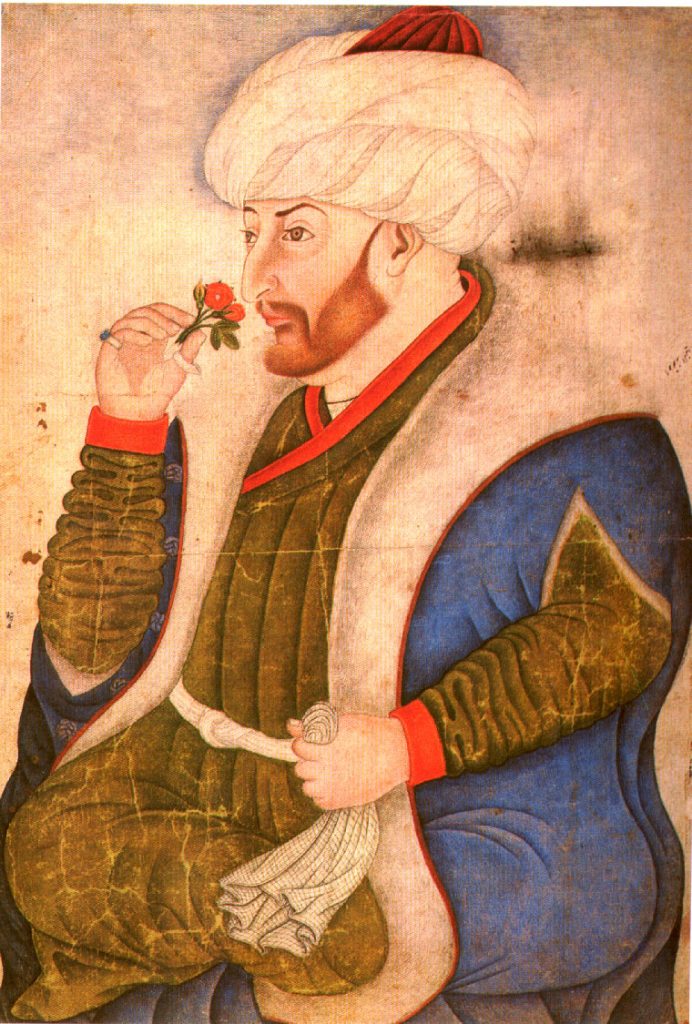
Among the surviving portraits of the Ottoman sultan Mehmed the Conqueror (1432–1481), the work that possesses the most profound layers in terms of art history and cultural sociology is undoubtedly the miniature of “Mehmed the Conqueror Smelling a Rose.” Preserved in the Library of the Topkapı Palace Museum (H. 2153, fol. 10a), this work records not merely the physical appearance of a ruler, but also the world of faith and values of the civilisation he represented, with flawless aesthetics.
2. Historical Context and Artistic Framework
2.1. Mehmed the Conqueror’s Patronage of the Arts
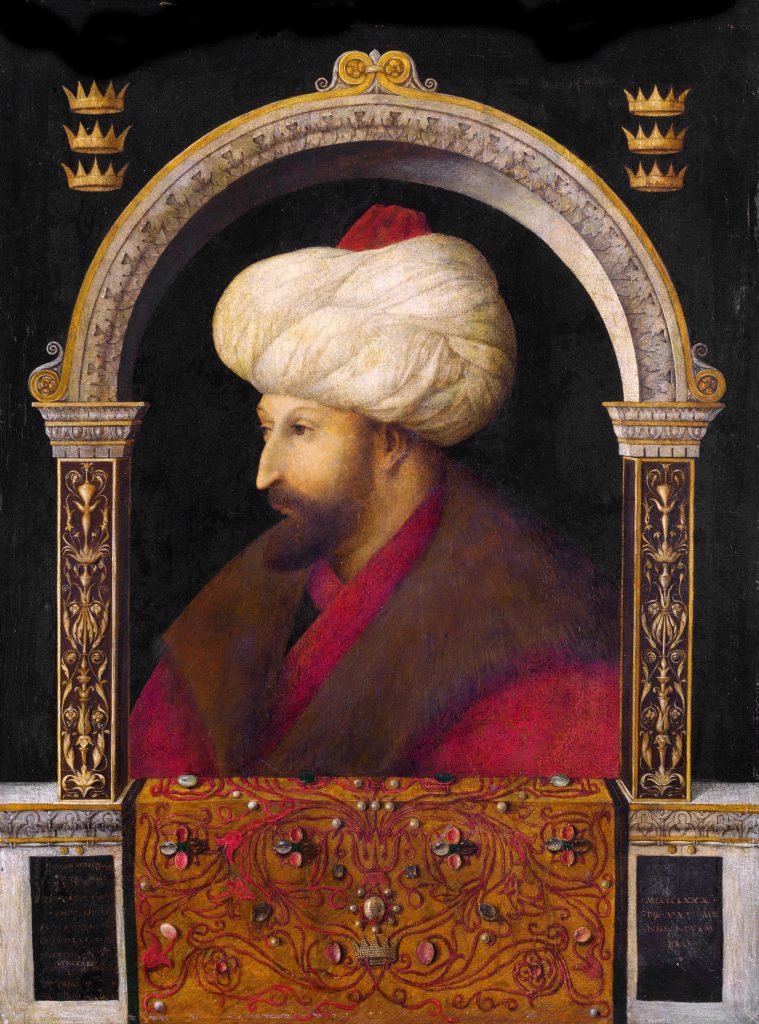
Mehmed the Conqueror went down in history not only as the conqueror of Istanbul but also as a great patron of the arts. Educated by the most distinguished scholars of his time, Mehmed II attached enormous importance to learning and art throughout his sultanate, established the Imperial Painting Studio (Hassa Nakkaşhânesi) in Istanbul, and brought numerous artists to the capital. The sultan’s interest in art was not confined to Islamic artistic traditions; he also took a great interest in Western painting. Indeed, at his request for “a good painter” from the Venetian doge, the important Renaissance figure Gentile Bellini came to Istanbul and worked at the palace between 1479 and 1481.
The Conqueror’s patronage of the arts paved the way for the formation of a cosmopolitan court culture that brought Eastern and Western artistic traditions together. That the painter Sinan Bey was sent to Italy to study under Maestro Paolo and, upon his return, painted the Conqueror’s portrait under the influence of Italian painting is a concrete example of this cultural interaction. In this context, the portrait of Mehmed the Conqueror smelling a rose should be regarded as a pioneering work that represents the synthesis of the Ottoman miniature tradition and Western painting techniques.
2.2. Artistic Features and Iconographic Elements of the Portrait
In the portrait attributed to the painter Sinan Bey, Mehmed the Conqueror is depicted sitting cross-legged, smelling a red rose held in his right hand. The sultan is portrayed from the left profile; with his thin, curved eyebrows, arched nose, and reddish moustache and beard, the portrait displays a detailed physiognomic realism. In the sultan’s right hand are three small roses of a red tending to orange; only one of these roses is fully open. The rose bouquet also includes a sprig consisting solely of leaves.
Alongside the rose, other iconographic elements in the portrait also draw attention. The white handkerchief firmly held in the sultan’s left hand, the zihgir (archer’s ring) on his thumb, and the turban on his head are counted among the symbols of sovereignty and status of the period. As Tuğba Batuhan states in her study, this portrait “presents Sultan Mehmet II as the Conqueror of Constantinople but also embodies Ottoman cultural concepts”. In this context, the rose, together with the other symbolic elements in the portrait, should be evaluated as part of a meaningful whole that reflects the multifaceted identity of the sultan.
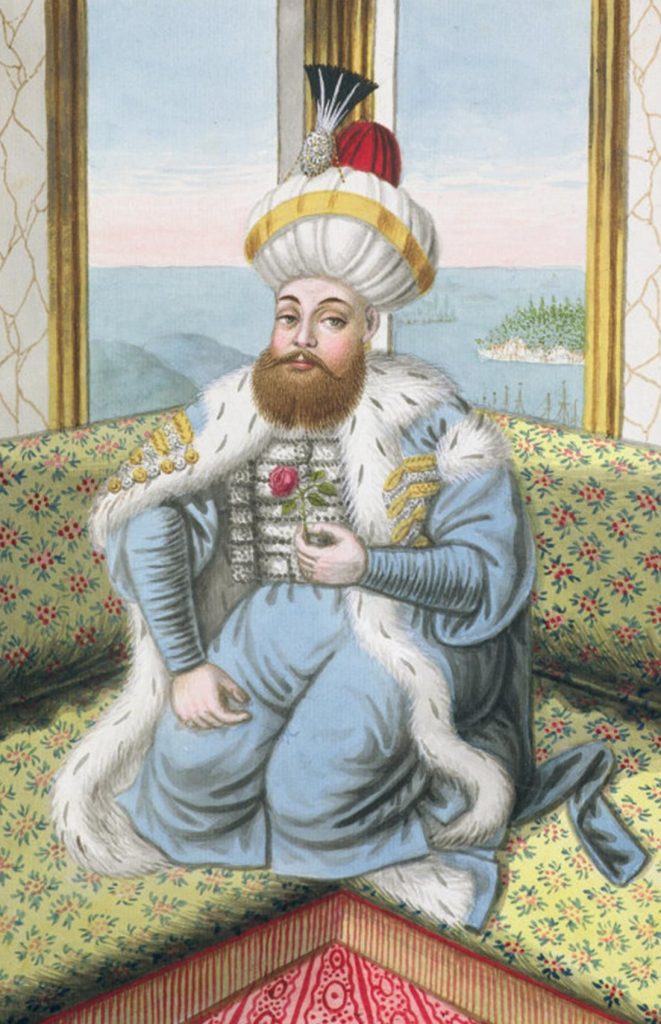
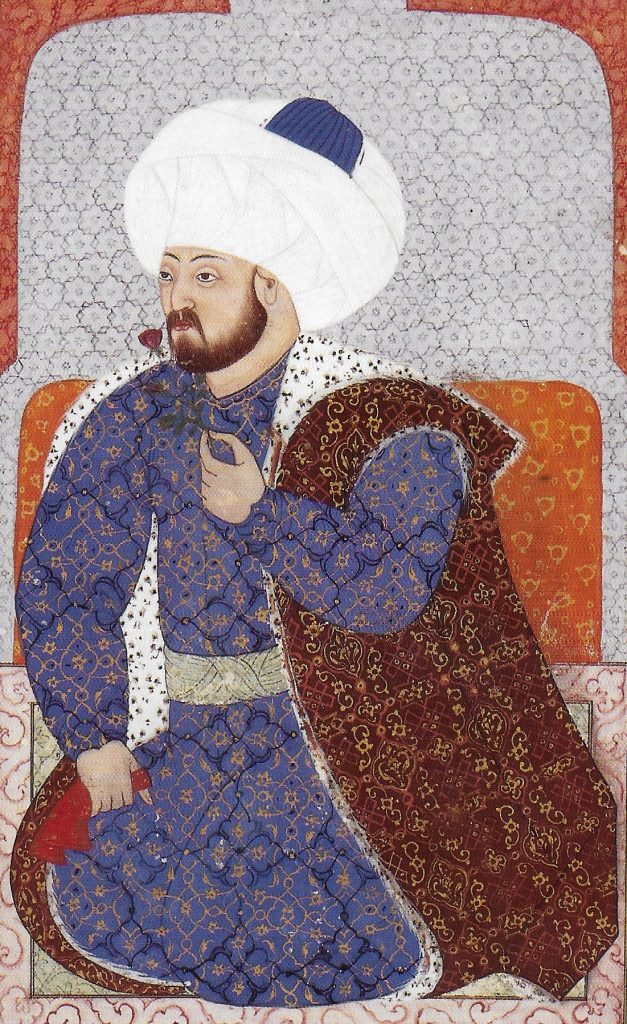
Sinan Bey’s portrait became a prototype for later representations of the Conqueror; it was repeated with similar compositions by various artists from the 16th to the 19th century.
3. Layers of Symbolic Meaning of the Rose
3.1. The Rose and the Symbolism of Prophet Muhammad in Islamic Sufism
The most widely accepted meaning of the rose in the Conqueror’s portrait is that it represents the Prophet Muhammad of Islam. This interpretation is based on the identification of the rose with the Prophet in the Islamic artistic and literary tradition. In Turkish-Islamic literature, in genres such as na’t, mevlid, hilye, and mi‘râcnâme, the rose has been used as one of the most important motifs symbolising the Prophet. The rose motif was established in Sufi terminology with the understanding that “just as the rose represents our Lord the Messenger of the Most Generous, the tulip symbolises the unity of God.”
The basis of this symbolic relationship lies in certain narrations that gained currency in Islamic culture. Stories such as the rose being created from the Prophet’s perspiration, and that those who wish to smell his scent should smell a rose, have found widespread place in folk belief and literature. However, academic studies have shown that these narrations are not reliable in terms of hadith scholarship and are classified as “fabricated hadiths”. As Beşir Ayvazoğlu elaborates in The Book of Roses, the rose’s association with the Prophet is a consequence of the impact that fabricated narrations created in cultural memory; yet this does not diminish the cultural validity or artistic value of the symbol.
Considering Mehmed the Conqueror’s profound devotion to Islam and to the Prophet, the interpretation that the rose in the portrait represents Muhammad stands out as a plausible one. The first Friday prayer that the Conqueror performed in Hagia Sophia after the conquest of Istanbul can be read as a manifestation of his assertion of transferring the symbolic centre of Islam to the capital of Eastern Rome. From this perspective, the image of Mehmed the Conqueror smelling a rose symbolises both the sultan’s religious identity and the role he assumed as the patron of Islamic civilisation.
3.2. Political Iconography: The Use of the Rose as a Symbol of the Caliphate and Civilisation
The rose’s representation of Prophet Muhammad can also be interpreted as a symbolic expression of Islamic civilisation and the office of the caliphate. After the conquest of Istanbul, Mehmed the Conqueror positioned himself not only as an Ottoman sultan but also as the leader of the Islamic world. In this context, the rose in the portrait can be evaluated as a visual expression of the sultan’s claim to represent Islamic civilisation.
As noted in the article “Legacy of greatness” in TES Magazine, one possible symbolic meaning of the rose is that it represents “the people of Islam protected by their armies (the petals and thorns)”. This interpretation rests on the association of the botanical structure of the rose (petals, thorns) with the protection and integrity of the Islamic community (ummah). The fact that the bouquet in the Conqueror’s portrait consists of three roses is also meaningful in this context; interpretations have been made that the three roses symbolise the presence of Islam across three continents (Asia, Europe, Africa) or the Ottoman dominion spreading over three continents.
Furthermore, it can be argued that the rose in the Conqueror’s portrait symbolises the expansion of Islamic civilisation westward with the conquest of Constantinople, the capital of the Eastern Roman Empire.
3.3. Mehmed the Conqueror’s Personal Character: Elegance, Contemplation, and Refined Spirit
Another layer of meaning of the rose in the portrait is that it offers clues to the Conqueror’s personal character. Despite being depicted with a robust physique and a majestic posture, the delicate rose he holds implies that alongside his warrior identity he possessed a graceful, refined spirit and a contemplative nature. As the interpretation in TES Magazine notes, the rose may represent “the sultan’s gentle, cultured sides”.
The intellectual identity of Mehmed the Conqueror is also confirmed by historical sources. The survival to the present day of a sketchbook from the sultan’s youth proves his drawing ability and artistic interest. Moreover, the poems the Conqueror wrote under the pen name Avnî reveal his literary side. In this context, the rose in the portrait can be evaluated as a visual complement to the sultan’s image as a “scholarly ruler.”
The Conqueror’s Childhood Notebook – academia.edu
The rose’s association with contemplation is also important. In Islamic mysticism, the rose has been used as a motif symbolising a state of contemplation and meditation. The sultan’s expressionless, pensive gaze and the act of smelling the rose in the portrait give the impression that he is depicted in a moment of contemplation. This interpretation gains further meaning when we consider the Conqueror’s interest in Sufism and the close relations he cultivated with the leading Sufis of his time.
3.4. A Comparative Perspective with Rose Iconography in Western Art
To grasp the meaning of the rose in the Conqueror’s portrait, it is necessary to take into account the iconography of the rose in Western art. The interaction between the portrait of the Conqueror made by Gentile Bellini during his stay in Istanbul and Sinan Bey’s miniature is significant for understanding how rose symbolism was interpreted in two different cultural contexts.
In Western Christian art, the rose was particularly associated with the Virgin Mary; the “rose without thorns” (rosa sine spina) symbolised her sinlessness. In Byzantine Constantinople, the association of the Virgin Mary with the rose was also a widespread iconographic tradition. The reinterpretation of this Christian symbol in an Islamic context after the Conqueror’s conquest of Istanbul constitutes an intriguing example of cultural transformation and symbolic appropriation.
Although Gentile Bellini’s portrait of the Conqueror does not contain a rose, it is likely that the Italian painter was influenced by the symbolic language of the East during his time at the Ottoman court. Sinan Bey, on the other hand, is known to have blended the Western understanding of perspective and physiognomic realism with the Ottoman miniature tradition after the training he received in Italy. This mutual interaction may explain why the rose appears in the portrait as a universal symbol of beauty and refinement accepted in both cultures.
4. Discussions on Rose Symbolism in Academic Literature
4.1. The View that the Rose Represents Prophet Muhammad
The most widely accepted view in academic literature is that the rose in the Conqueror’s hand represents Prophet Muhammad. This view is based on the tradition of identifying the rose with the Prophet in Islamic art and literature. The study by Mehmet Necmettin Bardakçı titled “Some Thoughts on the Rose Symbol in Turkish Sufi Culture” demonstrates that the rose is one of the most powerful symbols representing the Prophet in the Sufi context.
Another argument supporting this view is that the respect and devotion of Ottoman sultans for the Prophet was frequently emphasised in artistic representations. Mehmed the Conqueror’s positioning of himself as the leader of the Islamic world after the conquest of Istanbul makes it meaningful that he used a motif symbolising the Prophet in his portrait. As clearly stated in the Wikipedia entry on Sinan Bey, “The rose in the painting evokes Muhammad, and therefore Islam”.
4.2. Multi-layered Meaning and Alternative Interpretations
However, confining the meaning of the rose solely to the Prophet Muhammad may mean overlooking the multi-layered meaning the symbol carries. As emphasised in the TES Magazine article, the rose has more than one possible symbolic meaning: it could represent Prophet Muhammad, the peoples of Islam, or the cultured aspects of the sultan. This polysemy should be considered a characteristic of the symbolic language of Ottoman art.
Tuğba Batuhan’s article titled “Materiality of Mehmet II Smelling A Rose Based on Gentile Bellini’s Painting with Cultural Perspective” addresses the rose in the portrait from a cultural perspective and argues that the symbol carries a meaning that reflects both Ottoman cultural concepts and the influences of Western art. According to Batuhan, the portrait “presents Sultan Mehmet II as the Conqueror of Constantinople, while these paintings also embody Ottoman cultural concepts”. This approach argues that the rose cannot be reduced to a single referent; rather, it should be read as a reflection of the complex cultural and political dynamics of the period.
4.3. Critique of Popular Interpretations and the Importance of the Academic Approach
Various interpretations regarding the meaning of the rose in the Conqueror’s hand circulate in popular culture and on social media. These include claims that the rose “symbolises the conquest of Istanbul,” “expresses the Conqueror’s secret sympathy for Christianity,” or “shows his connection with a mystical order.” Such interpretations lack academic foundation and are often speculative in nature.
An academic approach requires evaluating the rose symbol within its historical context and taking into account the artistic, cultural, and political dynamics of the period. In this context, the question of how the fabricated narrations about the rose affect the cultural validity of the symbol gains importance. Studies on the rose symbol in Turkish-Islamic literature reveal that the impact created by fabricated narrations in cultural memory played a determining role in the signification of the symbol. This situation highlights the function of academic research in passing popular beliefs through a critical filter.
5. Conclusion
The rose held in the right hand of Mehmed the Conqueror in the portrait painted by Sinan Bey possesses a symbolic content so rich that it cannot be reduced to a single meaning. As this article has demonstrated, the rose has at least three fundamental layers of meaning:
First, in the Islamic Sufi tradition and Turkish-Islamic literature, the rose is one of the strongest symbols representing Prophet Muhammad. In this context, the rose in the Conqueror’s hand expresses the sultan’s profound reverence for the Prophet and the role he assumed as the patron of Islamic civilisation. Second, from the perspective of political iconography, the rose symbolises Islamic civilisation, the office of the caliphate, and the Ottoman dominion spanning three continents. Third, the rose reflects qualities of the Conqueror’s personal character such as elegance, contemplation, and a refined spirit, complementing the image of the sultan as a “scholarly ruler.”
This multi-layered pattern of meaning should be considered a characteristic of the symbolic language of Ottoman art. The rose has taken its place in the portrait at the intersection of Eastern and Western artistic traditions as a universal symbol of beauty and refinement, bringing together different cultural references. The image of the Conqueror smelling a rose became an iconographic model repeated over the centuries, and an inseparable part of the sultan’s representation in historical memory.
In conclusion, the rose in Mehmed the Conqueror’s hand is a complex symbol that represents not a single person or concept, but the multifaceted identity of a civilisation, a faith, and a ruler. To grasp the meaning of this symbol requires an interdisciplinary approach and a deep understanding of the historical context.
References
- Ayvazoğlu, Beşir. Güller Kitabı: Türk Çiçek Kültürü Üzerine Bir Deneme. İstanbul: Kapı Yayınları, 2016.
- Babinger, Franz. Mehmed the Conqueror and His Time. Translated by Ralph Manheim. New Jersey: Princeton University Press, 1978.
- Bağcı, Serpil, Filiz Çağman, Gürsel Renda, and Zeren Tanındı. Osmanlı Resim Sanatı. İstanbul: T.C. Kültür ve Turizm Bakanlığı Yayınları, 2006.
- Bardakçı, Mehmet Necmettin. “Türk Tasavvuf Kültüründe Gül Sembolü Üzerine Bazı Düşünceler”. In Gül Kitabı- Gül Kültürü Üzerine İncelemeler, ed. Bilal Kemikli and Selami Turan. Isparta: Isparta Belediyesi Kültür ve Sosyal İşler Müdürlüğü Yayınları, 2010.
- Batuhan, Tuğba. “Materiality of Mehmet II Smelling A Rose Based on Gentile Bellini’s Painting with Cultural Perspective”. Art-Sanat 14 (2020): 1-16.
- Berk, Nurullah. “Fatih Sultan Mehmet ve Venedikli Ressam Gentile Bellini”. Ankara Üniversitesi İlahiyat Fakültesi Dergisi 2/2 (1953): 143-160.
- İnalcık, Halil. Fatih Devri Üzerinde Tetkikler ve Vesikalar. Ankara: Türk Tarih Kurumu, 2007.
- Renda, Gürsel. Osmanlı Minyatür Sanatı. İstanbul: Promete Kültür Dizisi, 2001.
- “Türk-İslâm Edebiyatında Gül Sembolü ve Gül Hakkındaki Uydurma Rivayetlerle İlişkisi”. Dokuz Eylül Üniversitesi İlahiyat Fakültesi Dergisi. Accessed April 17, 2026. https://dergipark.org.tr/tr/pub/deuifd/article/450956.
- “Legacy of greatness”. TES Magazine, March 4, 2005. Accessed April 17, 2026. https://www.tes.com/magazine/archive/legacy-greatness.
- “Nakkaş Sinan Bey”. Wikipedia. Accessed April 17, 2026. https://tr.wikipedia.org/wiki/Nakka%C5%9F_Sinan_Bey.
- “Fatih Sultan Mehmed’in Gül Koklarken Tasvir Edildiği 5 Portre”. Tarih-i Kadim. Accessed April 17, 2026. https://www.tarihikadim.com/fatih-sultan-mehmetin-gul-koklarken-tasvir-edildigi-5-portre/.
⚖️
License and Copyright Notice
Media usage rules
Check the license/copyright information for all media files (images, videos, audio, documents, etc.) included in this content from the relevant work descriptions.
📚 Read the Terms and Conditions