

The Mi‘raj in Art and Music: Sultan Muhammad’s Cosmic Vortex and Beethoven’s Mystical Ascension
Explore the mystical Mi‘raj through the eyes of two geniuses: the dizzying golden vortex of Safavid miniaturist Sultan Muhammad and the ecstatic “Chorus of the Dervishes” by Ludwig van Beethoven. A transcultural journey where art and music depict the Prophet’s sacred ascension.
Introduction: A Journey Beyond Time and Space
The Mi‘raj, the most mystical and metaphysical turning point of Islamic faith, is a story of “ascension” that has challenged the comprehension not only of theologians but also of artists for centuries. The taking of the Prophet Muhammad (peace be upon him) one night from al-Masjid al-Haram to al-Masjid al-Aqsa, and from there, beyond the limits of the material realm, being raised through the heavenly spheres, is the moment when “the impossible is made possible.”
This event, while being attempted to be contained within miniature pages in Eastern Islamic art, found expression in symphonic music in the West. In this article, we will bring together the famous “vortex” from the brush of Sultan Muhammad, the genius of the 16th-century Tabriz atelier, and the notes of Beethoven rising from 19th-century Vienna, to examine in depth how art immortalized this sacred journey.
1. A Visual Revolution: Sultan Muhammad and the “Turning Sky”
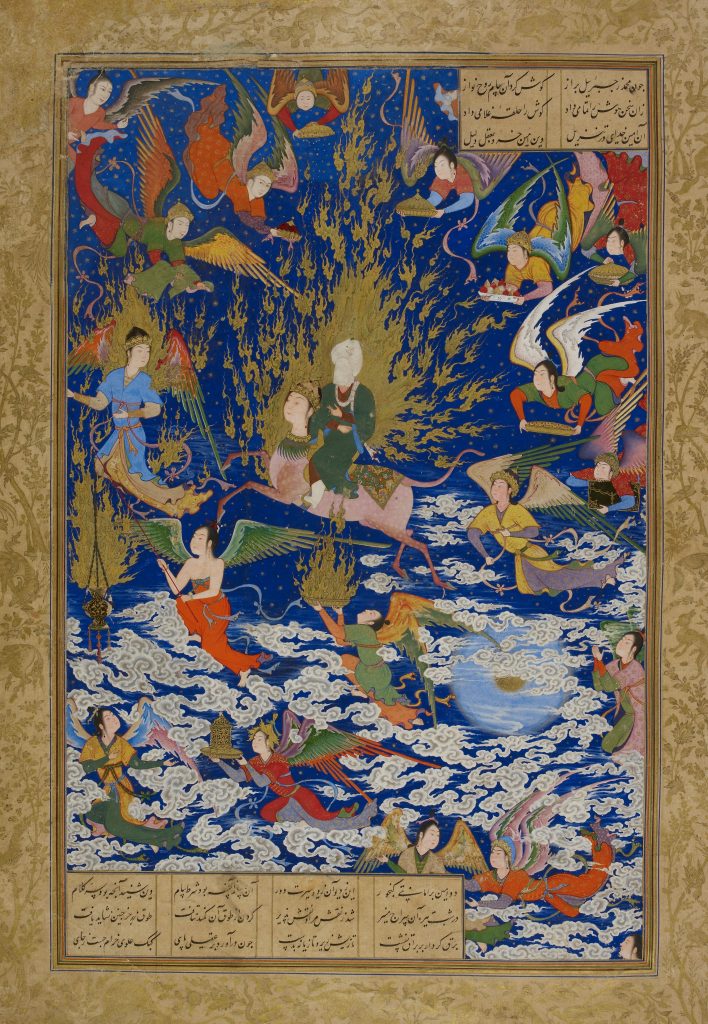
The work we are examining is found in a very special copy of Nizami Ganjavi’s Khamsa (British Library, Or. 2265), prepared for Shah Tahmasp between 1539 and 1543, considered the “Golden Age” of Safavid art. The architect of the work is Sultan Muhammad, the head painter of the Tabriz school and known as the “Sultan of Painters” of his time.
In classical miniature art, scenes are generally static; figures are lined up side by side as if on a theater stage. However, in this work, Sultan Muhammad made a revolution that would go down in art history:
- Cosmic Vortex (Composition): The miniaturist destroyed the classical geometric order to convey the “dizzying” speed of the Mi‘raj. At the center of the painting are the Prophet and his mount Buraq; but everything around them—angels, clouds, and stars—whirls as if within a maelstrom. This circular composition gives the viewer the sensation that the figures are being drawn upward, toward infinity.
- The Language of Colors: The deep navy blue (lapis lazuli) used to depict the night symbolizes eternity and the unknown; while the intense gold gilding around the Prophet represents the piercing of darkness by divine light.
2. Iconographic Details: The Veil, the Flame, and the Angels
Sultan Muhammad presents the pinnacle of Islamic aesthetics not only through composition but also through the symbols he employs.
- Depiction of Sanctity: In accordance with the tradition of reverence in Islamic figurative art, the face of the Prophet is covered with a white veil (niqab). This signifies that “his beauty and light are too sublime to be seen with the material eye.” The halo around his head is not circular as in Western art, but in the form of a flame. This flaming halo is a symbol of the “light of prophethood” (nūr al-nubuwwa) unique to Eastern art.
- The Flurry of the Angels: The angels in the painting are not mere spectators but active participants in the event. They hover around Buraq like moths, holding censers, trays full of light, and gifts. While Gabriel (peace be upon him) performs the duty of guide, the flapping wings of the other angels fuel that tremendous dynamism in the painting.
3. An Unexpected Echo from the West: Beethoven
The Mi‘raj, so vivid and colorful in the visual memory of the East, surprisingly also found an echo in the world of Western music’s genius, Ludwig van Beethoven. The winds of “Orientalism” and “Turquerie” (Turkish fashion) blowing through 19th-century Europe also swept Beethoven under their influence. Although the theatrical text (libretto) of the work, due to the political atmosphere of the period, contains stereotyped and even at times orientalist distancing towards the East and the Turks, Beethoven’s music transcends these political boundaries. Composing the music for The Ruins of Athens (Die Ruinen von Athen, Op. 113) in 1811, Beethoven, in one of the work’s most striking sections, the “Chorus of the Dervishes” (Chor der Derwische), goes beyond the text and transports the listener to the mystical atmosphere of the East.
- Musical Mi‘raj: In this section, Beethoven used abundant percussion in the orchestration to imitate the dhikr and whirling rhythm of the Mevlevi dervishes. The music’s gradually accelerating structure (crescendo) creates a state of “trance” and “ascension,” just like the vortex in Sultan Muhammad’s painting.
- Buraq and the Kaaba: When the German lyrics of the work are examined, it is seen that Beethoven directly used concepts of Islamic culture.
The chorus exclaims: “You bore the moon in the folds of your sleeves and shattered it to pieces. Kaaba! Muhammad! You mounted the radiant Buraq and flew to the seventh heaven, Great Prophet! Kaaba!”
What is interesting here is that a Western composer interpreted the image of “Buraq” and the theme of “Ascension to Heaven” with the East’s own instrument, “mystical ecstasy.”
Conclusion: Different Languages of the Same Truth
That golden vortex created by Sultan Muhammad in 16th-century Tabriz still continues to make our heads spin today. One depicted a silent ascension with his brush, the other made this ascension audible with his notes.
And although centuries and continents lie between them, both geniuses united in the greatest desire of the human spirit: to transcend boundaries and reach eternity. These works show us that truth is one, but art has an infinite number of languages to tell it.
Bibliography
- Welch, S. C. (1979). Wonders of the Age: Masterpieces of Early Safavid Painting. Harvard University Press. (Detailed analysis on Sultan Muhammad and the Tabriz School).
- British Library Collection, Khamsa of Nizami (Shah Tahmasp copy), Or. 2265, Folio 195r. (Original source of the work).
- Beethoven, L. v. (1811). Die Ruinen von Athen, Op. 113: No. 3, Chor der Derwische (Chorus of the Dervishes). (Source of the musical work and libretto).
- Tanındı, Z. (1984). Siyer-i Nebî: İslam Tasvir Sanatında Hz. Muhammed’in Hayatı. Hürriyet Vakfı Yayınları. (Reference for Islamic iconography).
⚖️
License and Copyright Notice
Media usage rules
Check the license/copyright information for all media files (images, videos, audio, documents, etc.) included in this content from the relevant work descriptions.
📚 Read the Terms and Conditions