

Jean-Baptiste Vanmour’s “Recueil de cent estampes représentant différentes nations du Levant”: The Visual Construction of the East Through European Eyes
Explore Jean-Baptiste Vanmour's 1714 "Recueil de cent estampes," a groundbreaking engraving album that shaped European perceptions of the Ottoman world through 100 hand-colored plates of costumes, ceremonies, and ethnic groups.
Europe’s curiosity about the Ottoman world acquired a new visual language at the beginning of the 18th century, partly through the influence of the printing press. One of the most accomplished examples of this language is the engraving album Recueil de cent estampes, produced from the canvases of the Flemish-born painter Jean‑Baptiste Vanmour under the patronage of the French ambassador Charles de Ferriol. Published in Paris between 1714 and 1715, the work re-constructed the East in the eyes of the West through one hundred plates that classified Ottoman society according to ethnic, religious and occupational groups from a Western perspective; for many years it served as a reference source that nourished both scholarly and artistic production. This article aims to examine the album’s historical context, content, production process, artistic features and cultural impact by drawing on the relevant sources.
1. Historical Context
Appointed French ambassador to Istanbul in 1699, the Marquis Charles de Ferriol d’Argental (1652–1722) brought with him the young painter Jean‑Baptiste Vanmour (1671–1737) and charged him with documenting the various nations, occupational groups and ceremonies of the Ottoman capital. Ferriol’s aim was to transform the East into a visual inventory for the court of Louis XIV and for the European public. From 1699 until his death Vanmour remained in Istanbul, where he recorded on canvas the daily life of the Tulip Era, official reception ceremonies, palace officials and ethnic groups, working first under Ferriol’s patronage and later under that of succeeding ambassadors.
When Ferriol returned to France in 1711, he took with him nearly a hundred of Vanmour’s oil paintings. The ambassador engaged the publisher Jacques Le Hay and a group of master engravers to turn these pictures into a collection of engravings that would bear his own name. The book appeared in 1714 under the title Recueil de cent estampes and was completed the following year with a volume of text. The work was soon translated into English, German, Italian and Dutch, becoming known throughout Europe as the “Recueil Ferriol”.
2. Structure and Content of the Work
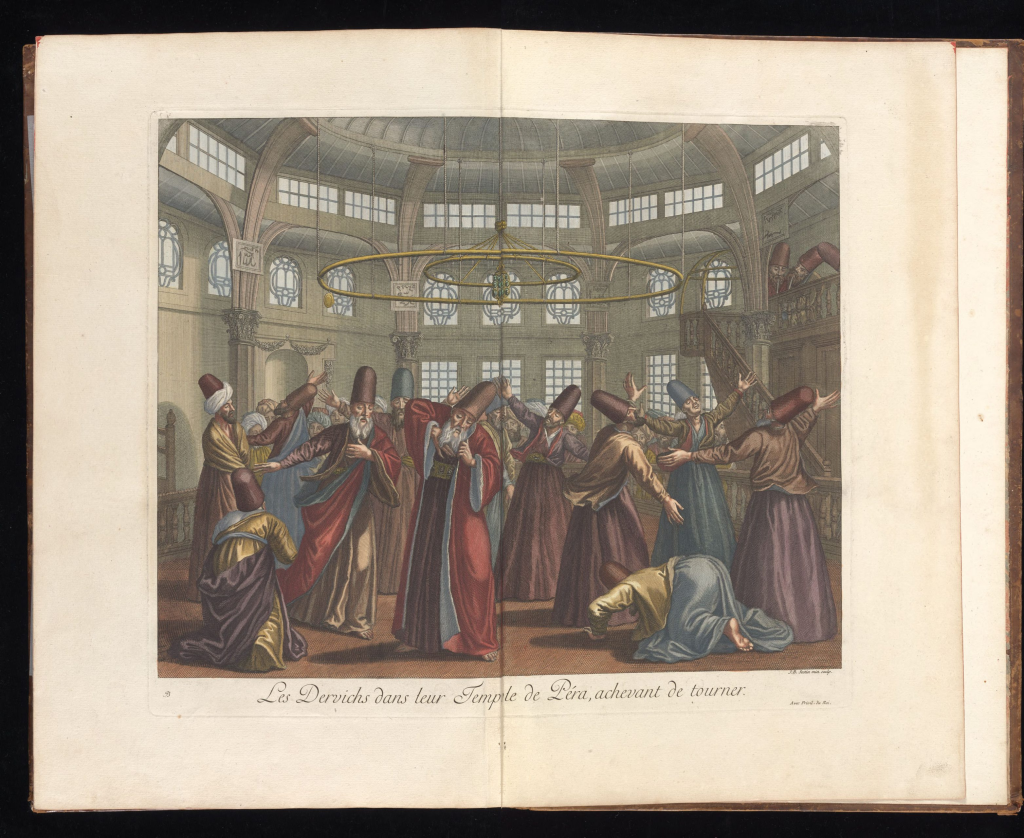
The album was produced in large folio format. In addition to the 100 numbered engraved plates, it contains two unnumbered double‑page plates (a Turkish wedding and a funeral), a full‑page plate showing Mevlevî dervishes performing their dhikr, and a leaf of music, making a total of 102 engraved plates. The 1715 edition of the book was sold together with a volume of French text, the Explication des cent estampes, which described each plate.
The content can be examined in two main sections:
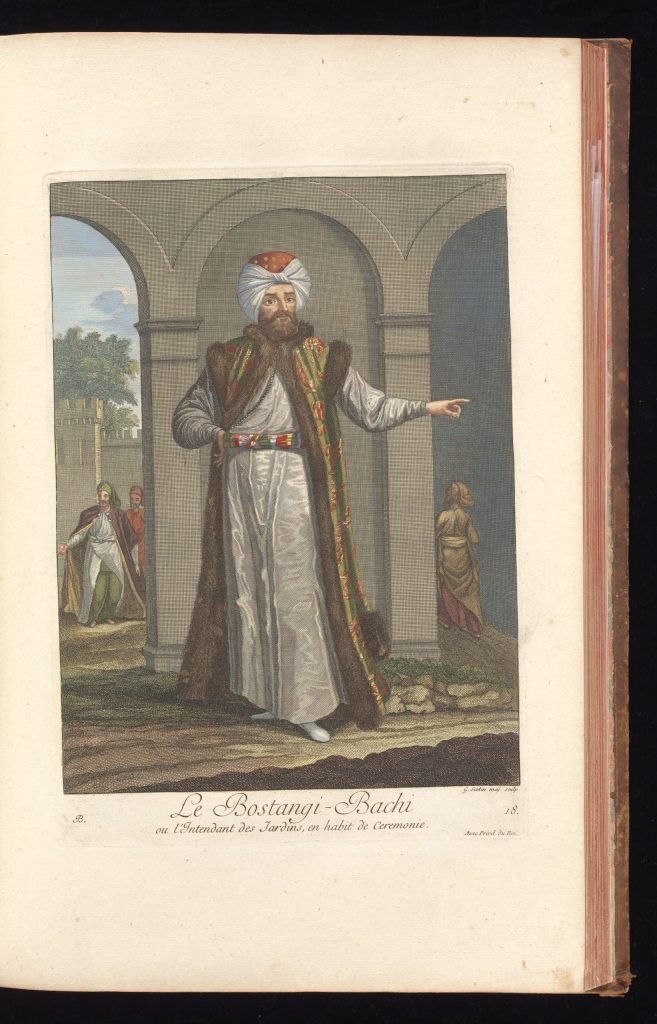
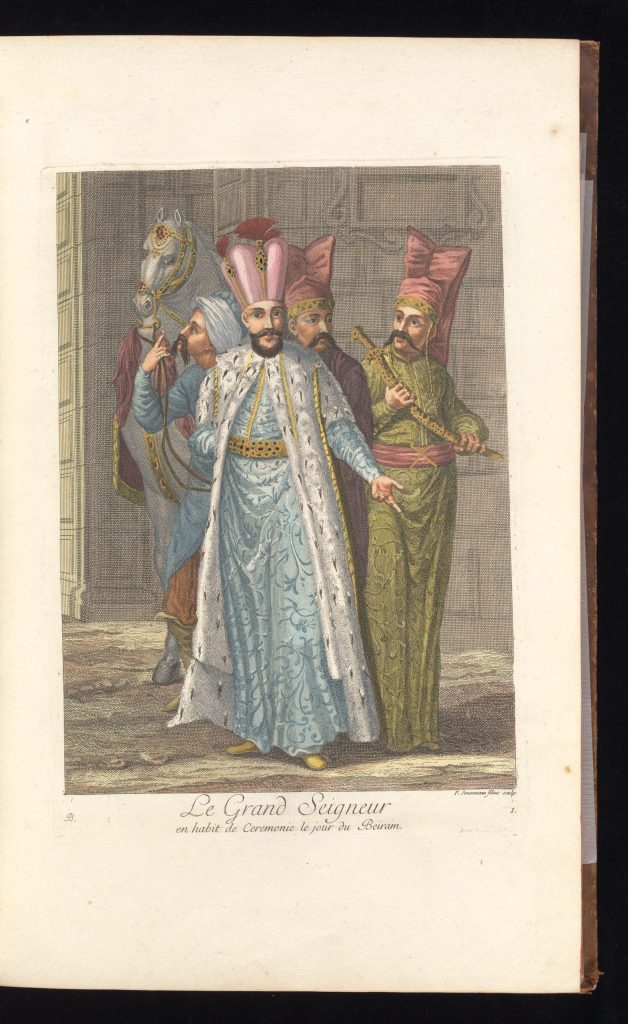
- The first 60 plates reflect the Ottoman palace hierarchy, depicting one by one official figures such as the sultan (Ahmed III), the valide sultan, the kadıns, viziers, the kapıcıbaşı and the bostancıbaşı.
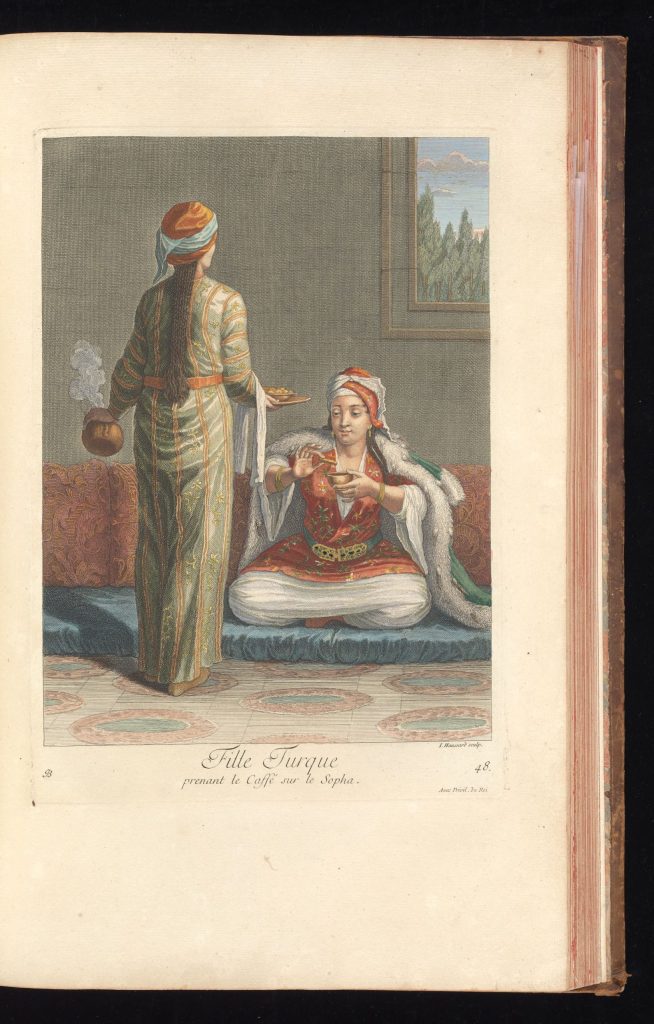
- The remaining 40 plates show the ethnic and religious groups within the borders of the Empire (Greek, Armenian, Jewish, Albanian, Arab, Persian, Indian, African, etc.) as well as artisan and tradesman classes (furrier, helva-maker, barber, florist).
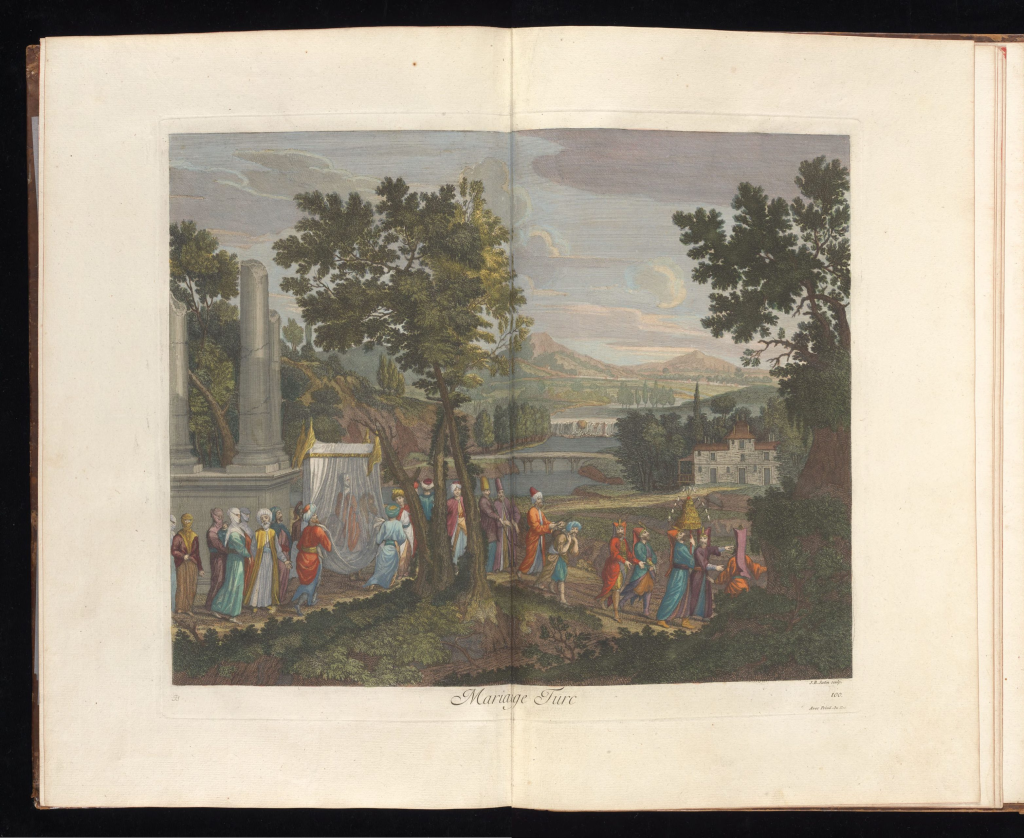
The two large folding plates at the end of the work depict, respectively, a Turkish wedding and a funeral. In addition, Mevlevî dervishes in sema appear on an unnumbered plate. These plates record not only the ethnographic but also the ritual dimension of Ottoman society.
3. Production Technique and Artistic Value
The most esteemed copper‑engraving masters of the period worked on the production of the engravings: Philippe Simonneau, Gérard Scotin (father and son), Claude Du Bosc, Jean‑Baptiste Haussard, Charles‑Nicolas Cochin, Bernard Baron and Jacques de Franssières. Vanmour’s compositions, which combined the European academic painting tradition with the light and colour sensibilities of the East, were reduced by the engravers to black‑and‑white line; each plate was then hand‑coloured with watercolour. In archival copies, the thin guard tissues placed behind the figures prevented the colours from dispersing over time and have preserved their vividness to the present day.
Vanmour’s paintings go beyond a Western artist’s depiction of the East as an “exotic” scene. While applying European rules of perspective, the artist also adopted the flat surface and vibrant colour approach nourished by the Ottoman miniature tradition. Indeed, when Vanmour’s portrait of Sultan Ahmed III is compared with the miniature of the same sultan by the celebrated court painter Levnî, the similarity in colour choices and sense of balance between the two artists is striking. This aesthetic exchange between two cultures transforms the Recueil from an ordinary costume album into a document of “visual intercultural dialogue.”
4. Publication Process and Versions
The first edition of the Recueil was printed in 1714 at the press of Jacques Collombat, in partnership with Le Hay and Duchange, and consisted solely of engravings. The volume of text published the following year (1715), the Explication des cent estampes, contained the French text explaining the plates as well as an additional section entitled “Anecdotes de l’Ambassade de M. de Ferriol” and the musical notation of a dervish hymn. This addition can be read as an attempt to make Ottoman culture “audible,” enriching the ethnographic claim of the work with a musical dimension.
Because the first copies sold out immediately after printing, a second edition was released within the same year; this edition was essentially a new impression and was sold together with the text volume. Throughout the 18th century the album was repeatedly pirated and reproduced by different publishers in reduced formats and with a smaller number of plates. In 1980, the Library of the Turkish Historical Society published a facsimile of the work under the title On sekizinci yüzyılın başında Osmanlı kıyafetleri (Ottoman Costumes at the Beginning of the Eighteenth Century).
5. Impact and Legacy
The influence of the Recueil de cent estampes is evident in three areas:
- The Birth of Orientalism: The album inspired leading Rococo figures such as Antoine Watteau and François Boucher and served as the principal visual repository for the spread of the Turquerie fashion.
- Scholarly Reference: In the 18th and 19th centuries it was accepted as a primary visual source by travel writers, ethnographers and costume historians. The final section documenting the dress of Ottoman ethnic groups, in particular, remains an iconographic archive consulted by researchers even today.
- Cultural Diplomacy: Prepared under the patronage of an ambassador, the work is also a striking example of early modern cultural diplomacy practices. In introducing Ottoman society to a French readership, it is evaluated in Western literature that this work simultaneously functioned as a visual argument that legitimised the necessity of relations with the East.
Vanmour, Jean-Baptiste. “Recueil de cent estampes representant differentes nations du Levant…” (1714). The digital copy of this work is presented in the public domain via the Internet Archive.
6. Conclusion
The Recueil de cent estampes, which issued from the brush of Jean‑Baptiste Vanmour and was multiplied by the hands of master engravers, is a publication that radically changed the way Europe perceived the Ottoman Empire at the beginning of the 18th century. At the same time, however, the album should also be read as a Western construct that shows how Europe, driven by political and commercial motivations, categorised the East and transformed it into an exotic stage, rather than as a sociological mirror that grasped Ottoman society from within; with its artistic value, and also with the reductive (orientalist) perspective it contains, it is instructive for cultural history.
Both the product of a diplomatic commission and an interdisciplinary document, the album is today accessible to everyone thanks to the Internet Archive. Examining such digitised works offers new opportunities to understand how global visual culture was shaped in its early period.
A Visual Journey to 18th-Century Istanbul
Below is a small selection from the enormous 100-plate collection that launched the ‘Turkish Fashion’ (Turquerie) in Europe. To examine all of these rare works—which reflect the social fabric of the period, from the palace hierarchy to tradesmen, from dervishes to different faith groups—to lose yourself in the high-resolution details, and to explore our digital exhibition in its entirety, have a look at the collection.
7. Bibliography
- Vanmour, Jean-Baptiste (illus.). Recueil de cent estampes representant differentes nations du Levant, gravées sur les tableaux peints d’après nature en 1707 & 1708, par les ordres de M. de Ferriol, ambassadeur du roi a la porte, et mis au jour en 1712 & 1713 par les soins de M. Le Hay. Paris: Jacques Collombat, 1714 [1715]. Internet Archive. https://archive.org/details/gri_33125015119957.
- Explication des cent estampes qui représentent différentes nations du Levant avec de nouvelles estampes de cérémonies turques qui ont aussi leurs explications. Paris: Jacques Collombat, 1715. Bibliothèque nationale de France, Catalogue général. https://catalogue.bnf.fr/ark:/12148/cb393416972.
- BnF – Les essentiels de la littérature. “Femme persane: Jean-Baptiste Vanmour, le Recueil de 100 estampes représentant les différentes nations du Levant.” Montesquieu, Les Lettres Persanes exhibition page. Accessed May 10, 2026. https://expositions.bnf.fr/montesquieu/grand/ess_231.htm.
- Özkartal, Mehmet, and Kamile Akın. “Pedagojik Eleştiri Yöntemi ile Nakkaş Levni ve Ressam Vanmour’un Sultan III. Ahmed Portresinin Renk ve Kompozisyon Bakımından Karşılaştırılması” [Comparison of the Portrait of Sultan Ahmed III by Miniaturist Levni and Painter Vanmour in terms of Color and Composition through Pedagogical Criticism Method]. Bodrum Sanat ve Tasarım Dergisi [Bodrum Journal of Art and Design] 1, no. 2 (2022): 152-160. https://dergipark.org.tr/tr/pub/bodrum/issue/71127/1128538.
- Turkish Historical Society Library [Türk Tarih Kurumu Kütüphanesi]. On sekizinci yüzyılın başında Osmanlı kıyafetleri: Fransız Büyükelçisi Marquis de Ferriol’un Hollandalı ressam Van Mour’a yaptırdığı 100 resim ile Türklere ait… [Ottoman Costumes at the Beginning of the Eighteenth Century…]. Trans. Cenap Yazansoy. Ankara: Türk Tarih Kurumu, 1980. Call No: A/6461.
- Wikipedia. “Jean Baptiste Vanmour.” Last modified 2025. Accessed May 10, 2026. https://en.wikipedia.org/wiki/Jean_Baptiste_Vanmour.
- Sotheby’s. “Le Hay and de Ferriol | Recueil de cent estampes, 1714, folio, mottled calf.” Travel, Atlases, Maps & Natural History, 2022. (Online auction catalog, accessed May 2026).
- Christie’s. “Turquie – Le Hay, Jacques. Recueil de cent estampes représentant différentes Nations du Levant, 1714 [Avec:] Explication des cent estampes, 1715.” Livres et Manuscrits, 2022. (Online auction catalog, accessed May 2026).
⚖️
License and Copyright Notice
Media usage rules
Check the license/copyright information for all media files (images, videos, audio, documents, etc.) included in this content from the relevant work descriptions.
📚 Read the Terms and Conditions