

Osman Hamdi Bey: Bridging Archaeology and Art – The Renaissance Man of the Ottoman Empire
Explore how Osman Hamdi Bey, the Ottoman painter, archaeologist, and museum curator, masterfully blended art and archaeology to forge a unique cultural identity. Discover his masterpieces, his groundbreaking archaeological discoveries like the Alexander Sarcophagus, and his enduring legacy on Turkish and world heritage.
Osman Hamdi Bey is the cornerstone of Turkish painting, museology, and archaeology. Defining him solely as a painter or merely a museum curator would be an injustice to his multifaceted genius. He is a “Renaissance man.” The most visible and compelling synthesis of this versatility undoubtedly emerges at the intersection of his passion for painting and archaeology. Every figure, every architectural detail, and every archaeological object he projected onto his canvas is, in fact, a reflection of his profound historical consciousness, his quest for identity, and his effort to reconstruct a civilization. In this article, we will read Osman Hamdi Bey’s masterpieces through the lens of his archaeological passion and analyze in depth how these two great passions nourished each other to create immortal works.
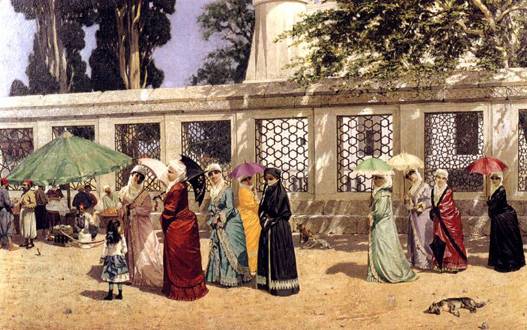
Osman Hamdi Bey: An Intellectual Raised in the West, Who Assimilated the East
The life story of Osman Hamdi Bey is a key to understanding his art. He was born in 1842, during the most fervent reform period of the Ottoman Empire, into a prominent family. His father, Grand Vizier İbrahim Ethem Pasha, sent him to Paris to study law. However, Paris ignited in the young Osman Hamdi a passion for art rather than law.
During this period, he had the opportunity to work in the studios of the renowned painters of the time, Jean-Léon Gérôme and Gustave Boulanger. These teachers, strong representatives of the Orientalist movement, depicted the East in an exotic and sometimes unrealistic manner. Osman Hamdi learned these representations but eventually challenged them. While acquiring the technical mastery of the West, he developed a respectful, “insider’s” gaze towards his own culture, the East. This dual identity—the technique of a Western artist and the perspective of an Eastern intellectual—formed the foundation of all his works.
The Gateway to Archaeology: “Kaşif-i Esrar-ı Antika” (The Discoverer of the Secrets of Antiquities)
Osman Hamdi Bey’s formal involvement with archaeology began with his appointment as director of the Müze-i Hümayun (Imperial Museum) in 1881. This appointment marked a turning point for Turkish museology and archaeology. Until then, ancient artifacts in Ottoman territories were mostly excavated by Western archaeologists and smuggled abroad. This amounted to the systematic plundering of Anatolia’s memory.
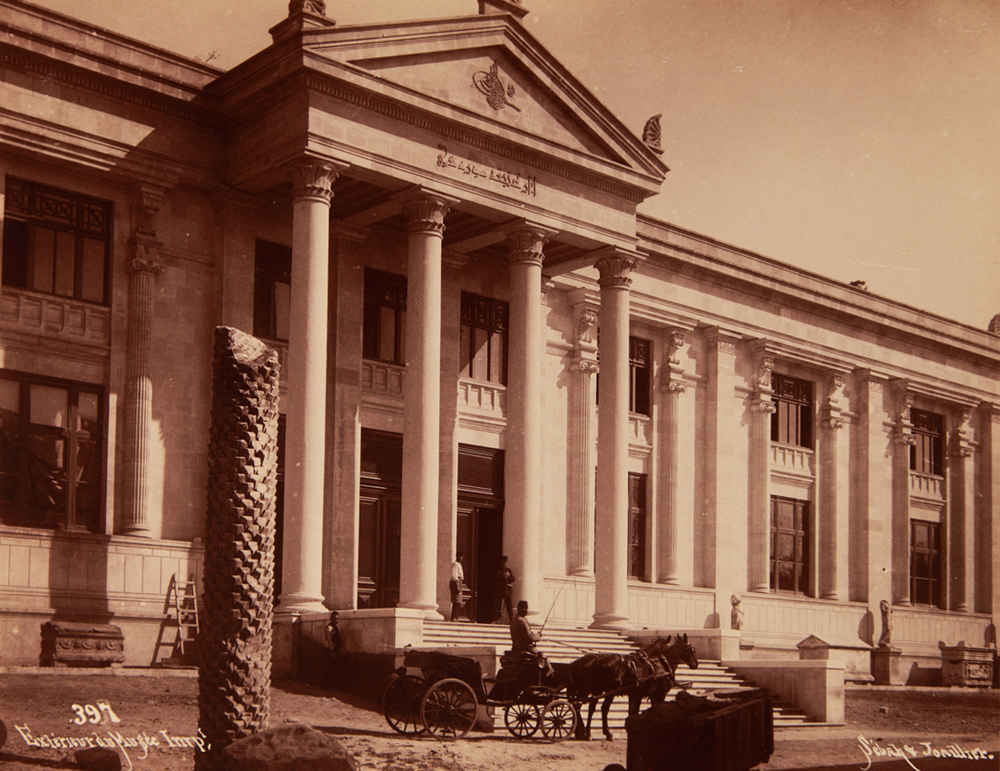
Osman Hamdi Bey took action to put a stop to this. The “Eski Eserler Kanunu” (Antiquities Law – Asar-ı Atika Nizamnamesi) enacted in 1884 was the first comprehensive antiquities protection law in Turkey. This radical law prohibited the export of historical artifacts abroad and laid the foundations for the preservation of Anatolia’s rich archaeological heritage. This move not only imposed a ban but also claimed sovereignty over the cultural patrimony beneath Ottoman soil and embraced that heritage.
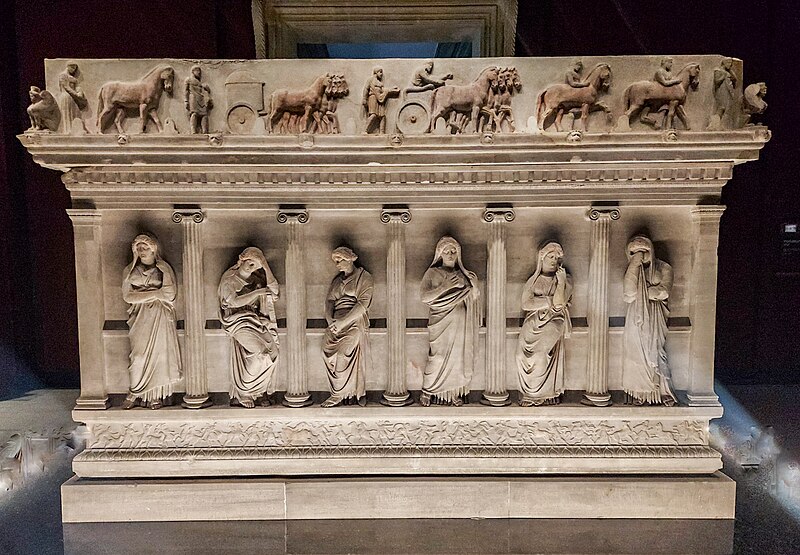
The pinnacle of his archaeological career was the Lagina (Muğla, Yatağan) and Sidon (Lebanon) excavations he conducted between 1887 and 1888. The Sidon excavation yielded a series of ancient sarcophagi that shook the world of archaeology, including the world-famous “Alexander Sarcophagus” and the “Sarcophagus of the Mourning Women.” These sarcophagi were not merely archaeological finds but also documents offering unique insights into the art, mythology, and daily life of the ancient world. This discovery enabled the Istanbul Archaeology Museums to become one of the most important museums in the world.
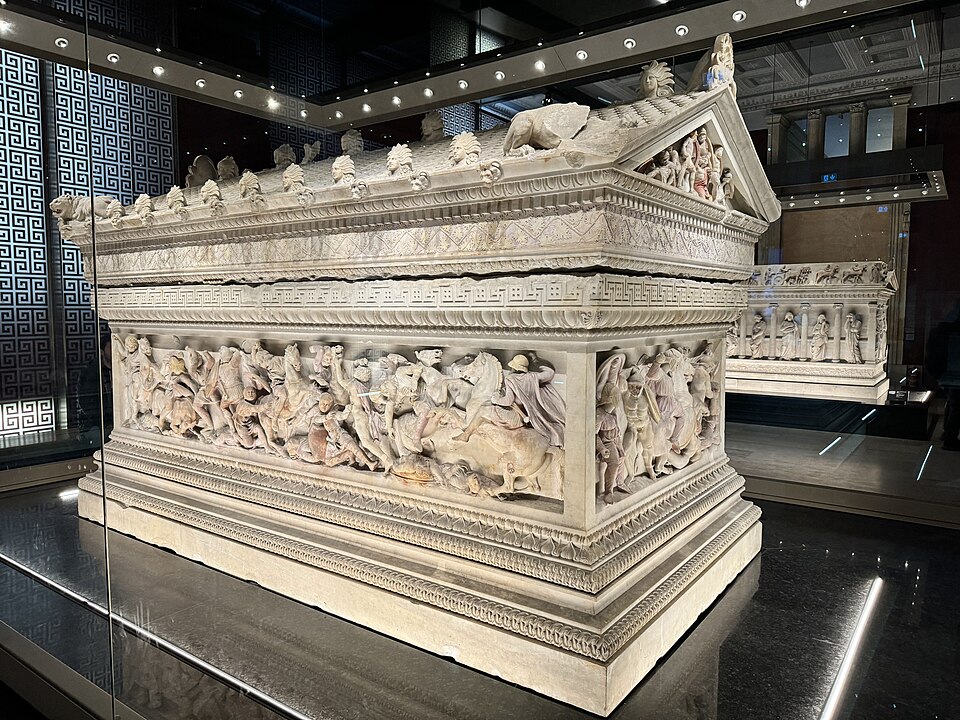
Alexander Sarcophagus, Istanbul Archaeology Museums 2024 – Image Source
Sarcophagus of the Mourning Women, Istanbul Archaeology Museums 2022 – Image Source
It was this “discoverer” identity that deeply nourished his art. The objects, spaces, and stories he encountered during the excavations would henceforth become the protagonists of his paintings. Archaeology was for him not only a source of knowledge but also a powerful muse.
Archaeology on Canvas: Reflections of the Ancient World in His Paintings
In Osman Hamdi Bey’s paintings, archaeology appears not merely as a decor or accessory, but as a fundamental element that carries the meaning, spirit, and message of the painting.
1. Use of Architecture and Space: Amidst the Layers of History
Osman Hamdi frequently employed historical settings in his paintings. The Yeşil Mosque in Bursa, the Çinili Köşk in Istanbul, and many other Ottoman edifices are often seen in his scenes. These spaces are not mere backdrops. By depicting them together with archaeological objects, the painter merges different layers of history within a single composition. This imparts a depth of “layered temporality” to his works. The viewer simultaneously witnesses the glorious Ottoman past and the traces of even older civilizations upon which that past was built.
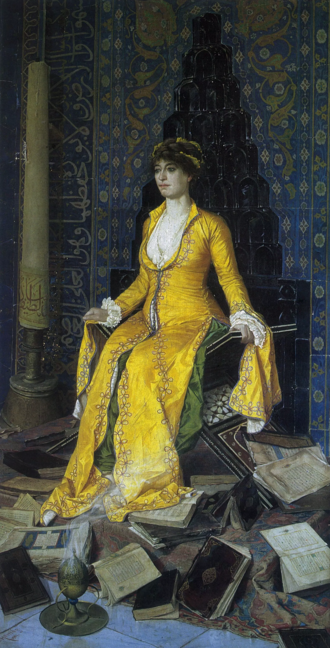
- “Mihrap” (1901): This masterpiece is the most striking example of this synthesis. A young woman is depicted before a mosque mihrab, surrounded by precious manuscripts scattered around her. The woman’s posture, the embroidery on her dress, and the books around her reflect the subtleties of Islamic art. Yet the composition is akin to a “still life” placed before a mihrab. Here, the mihrab is not only a religious element but also an archaeological and artistic object, a historical texture. Osman Hamdi presents a religious and cultural element as an object of archaeological curiosity and artistic beauty. This painting transforms a place of worship into a treasury of knowledge and art.
2. The Symbolism of Archaeological Objects: Silent Witnesses of the Past
The sarcophagi and other artifacts he discovered during the Sidon excavations directly became subjects of his paintings. These objects are not only rendered realistically but also function as powerful symbols.
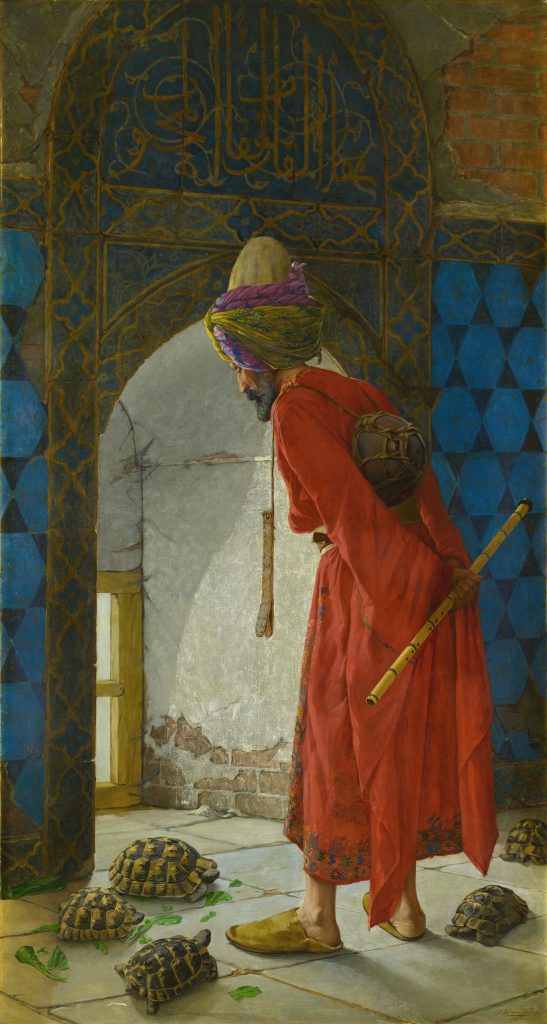
- “The Tortoise Trainer” (1906): In perhaps his most enigmatic painting, The Tortoise Trainer, the tiles and wall decorations visible in the background are inspired by historical buildings in Bursa. This setting enters the painting as an archaeological layer. While the ney (flute) in the trainer’s hand and the nakkare (drum) on his back represent traditional music and culture, the turtles he is trying to train symbolize a society that changes slowly and with difficulty. Here, the archaeological space (the historical building) forms the ground for social criticism and the loneliness of the intellectual. The splendor of the past and the slow progress of the present meet in the same frame.
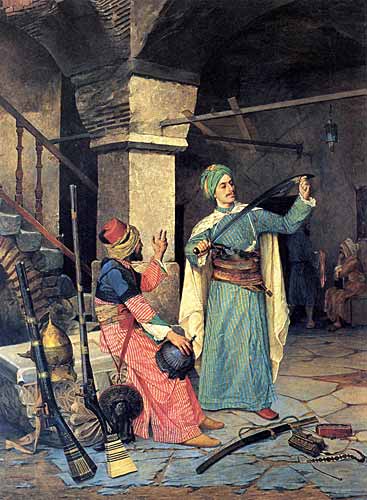
- “The Arms Dealer” (1908): Osman Hamdi Bey’s work The Arms Dealer is actually a self-portrait in which he and his son are depicted in historical costumes. In the painting, Osman Hamdi is shown seated on a column capital, a posture thought to allude to his role as a museum founder. Contrary to the hand gesture as if giving advice to his son, the son Ethem examines a drawn sword, representing youth and the new generation. The distinct headgear, sitting, and standing poses of the figures emphasize the generational gap.
3. Figures and Narrative: People Bridging Past and Present
The figures in Osman Hamdi Bey’s paintings are usually thoughtful, serene, and in a state of deep introspection. These figures are frequently in direct interaction with archaeological objects or historical settings. They are characters who build a bridge between the past and the present, who commemorate history or engage in a dialogue with it.
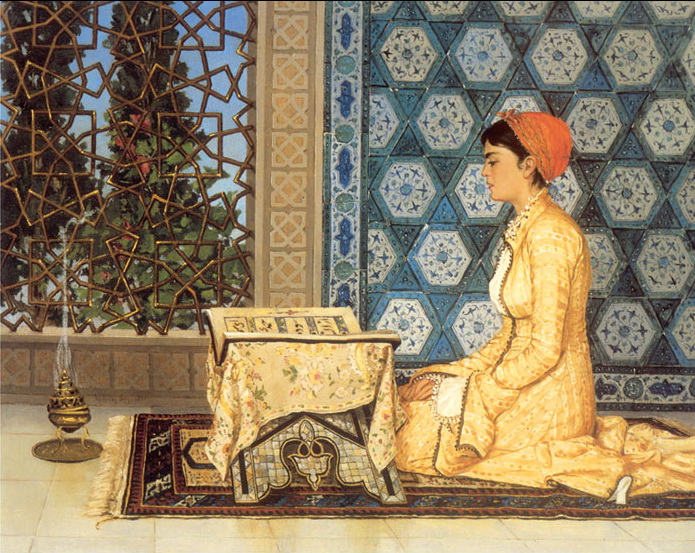
“Girl Reciting the Quran” (1880): This painting is one of the purest examples of Osman Hamdi Bey’s “insider” perspective on the East and the cultural depth he endows upon objects. In the early hours of the morning, in a modest room, a young girl in traditional attire reads the Quran on a rahle (book rest). This composition is a powerful reply to the exotic and passive harem depictions of Western orientalists. Here, the woman is a knowledgeable, devout, and self-confident individual. An important detail is the rahle, which is a wooden cultural object. Despite being an archaeologist, Osman Hamdi Bey deliberately chose a wooden rahle that is an organic part of everyday religious life, thereby authentically and respectfully reflecting his own culture. This is proof that his archaeological passion was always intertwined with a quest for an authentic cultural context.
A Response to Orientalism: Painting the East from the “Inside”
Western orientalist painters often depicted the East as an exotic, mysterious, lazy, and erotic world. In these representations, Eastern women appeared as passive objects in harem scenes. These images aimed to reinforce the West’s sense of superiority.
Art, Archaeology, and the Quest for Identity: The Sides of a Triangle
Osman Hamdi Bey’s paintings are, in fact, also the story of the identity quest of an intellectual from an empire in decline. Faced with the technological and scientific superiority of the West, he turned to the roots of his own civilization, to the ancient past of Anatolia and Mesopotamia. This was not merely an escape, but also an endeavor to construct a strong and enduring identity.
Archaeology gave him the means to concretely explore and embrace these roots. The sarcophagi he found in Sidon were proof that the Ottoman lands had been home not only to Islamic civilization but also to Phoenician, Hellenistic, and Roman civilizations. Painting, on the other hand, became the medium for conveying this discovery and this understanding of a multi-layered identity to society and the world.
His paintings seem to convey the message: “We are a nation that exists not only with our recent past but with all the ancient civilizations that have reigned in these lands. Our identity is multi-layered, and this richness is our strength.”
The convergence of Islamic architecture with the body of knowledge represented by books in the “Mihrap” painting, and the authentic depiction of daily religious practice in “Girl Reciting the Quran,” are aesthetic expressions of this search for identity. Even “The Tortoise Trainer” can be read as a metaphor for the search for a new identity and order within these ancient spaces. Through this synthesis, Osman Hamdi Bey offered a remarkably prescient vision of the role of art and science in the construction of modern Turkish identity.
The Legacy of Osman Hamdi Bey and Its Reflections on Contemporary Art
The legacy of Osman Hamdi Bey continues to influence artists and intellectuals today. His themes of identity, cultural heritage, and the East–West synthesis remain a rich reference point in contemporary art and cultural debates.
For instance, some artists reinterpret his “The Tortoise Trainer” in the context of today’s consumer society or the age of digital communication, prompting reflections on modern “trainers” and “turtles.” Others address his effort to depict the East from the “inside” within the framework of contemporary cultural stereotypes and identity politics.
Moreover, Osman Hamdi Bey’s identity as a museum curator and his awareness of protecting historical artifacts still serve as a compass for the preservation of cultural heritage, the role of museums, and the struggles against antiquities smuggling today. Without his efforts, a far greater part of Anatolia’s memory could have been erased, and we might never have possessed a treasure like the Istanbul Archaeology Museums.
Conclusion: An Immortal Legacy
Osman Hamdi Bey not only created beautiful works of art with his paintings but also documented a civilization’s new and critical relationship with its own past. His passion for archaeology was not just a profession or a hobby for him; it was a worldview. This passion transformed on his canvases into an aesthetic language that breathed life into the silent remnants of the past, charged them with contemporary meaning, and bridged East and West.
As an intellectual, he showed how an identity could be constructed by combining the power of art and science. Today, when we visit the Istanbul Archaeology Museums and look at the sarcophagi he discovered, or when we stand before one of his paintings and ponder deeply, we continue to ask the same question: “What does the past say to us?” To ask this question, Osman Hamdi Bey has left us not only his works but also a way of thinking, a perspective, and a legacy. As both a “Kaşif-i Esrar-ı Antika” (Discoverer of the Secrets of Antiquities) and a “Ressam-ı Kebir” (Great Painter) who immortalized those secrets with the universal language of art, he will forever hold his deservedly distinguished place not only in the history of Turkish culture but also in the history of world art and archaeology.
Paintings by Osman Hamdi Bey You Would Like to See;
🎮Learn by Playing
Osman Hamdi Bey Puzzle
Discover Osman Hamdi Bey’s works with a digital jigsaw puzzle
PLAY ➜
Bibliography and Further Reading Suggestions
Books
- Germaner, S., & İnankur, Z. (2017). Osman Hamdi Bey: Tablolarının Ayrıntılı İncelenmesi [Osman Hamdi Bey: A Detailed Analysis of His Paintings]. Türkiye İş Bankası Kültür Yayınları.
- Eldem, Edhem. (2021). Osman Hamdi Bey Sözlüğü [Dictionary of Osman Hamdi Bey]. Türkiye İş Bankası Kültür Yayınları.
- Shaw, Wendy M. (2023). Osmanlı Müzeciliği: Müzeler, Arkeoloji ve Tarihin Görselleştirilmesi [Ottoman Museology: Museums, Archaeology and the Visualization of History]. İletişim Yayınları.
- Öndeş, O. (2019). Osman Hamdi Bey: Aydın Bir Osmanlı İdarecisi, Müzeci, Ressam [Osman Hamdi Bey: An Enlightened Ottoman Administrator, Museologist, Painter]. Yapı Kredi Yayınları.
- Renda, G. (Ed.). (2019). Osman Hamdi Bey: Bir Osmanlı Aydını [Osman Hamdi Bey: An Ottoman Intellectual]. Türkiye İş Bankası Kültür Yayınları.
Articles and Academic Publications
- Bahrani, Z., Çelik, Z., & Eldem, E. (2011). “Scramble for the Past: A Story of Archaeology in the Ottoman Empire, 1753-1914”. Journal of the Society of Architectural Historians, 72(1), 121-123.
- Çelik, Z. (2022). “Osman Hamdi Bey’in ‘Mihrap’ı: İkonografi, Oryantalizm ve Eleştirisi” [Osman Hamdi Bey’s ‘Mihrab’: Iconography, Orientalism and Its Critique]. Sanat Tarihi Dergisi [Journal of Art History], 31(2), 589-615.
- Shaw, W. M. (2018). “From Mausoleum to Museum: Resurrecting Antiquity for the Modern Era in the Ottoman Empire”. Museum History Journal, 11(1), 1-20.
- İnankur, Z. (2015). “Osman Hamdi Bey: An Ottoman Artist in the Age of Empire”. International Journal of Middle East Studies, 47(4), 818-820.
⚖️
License and Copyright Notice
Media usage rules
Check the license/copyright information for all media files (images, videos, audio, documents, etc.) included in this content from the relevant work descriptions.
📚 Read the Terms and Conditions