
Ottoman Visual Witness: Matrakçı Nasuh and the Beyan-ı Menazil Miniatures
Explore the 16th-century topographic miniatures of Ottoman polymath Matrakçı Nasuh, who visually chronicled the Iraqayn campaign. Discover his unique “Matraki” style and the cities of Anatolia and the Middle East.
Introduction: “Seeing” and Recording History
Historiography is predominantly under the dominion of words. Chronicles, edicts, travelogues, and court chronicles “narrate” the past to us. Yet words, however powerful they may be, are by nature abstract. When we read the phrase “a magnificent city,” the image that comes to mind is not what the author saw, but what we imagine. Conveying the texture of stone, the grandeur of walls, the unique spirit imbued in a city’s topography flawlessly through words hits the limits of language. There are rare moments when this boundary is surpassed, when history transforms into a truth that is not only “read” but also “seen.” For the 16th-century Ottoman geography, the architect of this moment is, without doubt, Nasuh bin Karagöz bin Abdullah al-Bosnavī, or as we know him: Matrakçı Nasuh.
The year 1533 is a critical threshold when the Ottoman Empire was at the zenith of its power, yet tensions were escalating on its eastern frontier with the Safavid state. When Sultan Süleyman the Lawgiver decided to embark on the great Eastern campaign known as the “Sefer-i Irakeyn” (The Campaign of the Two Iraqs), among the army and state officials was a man as skilled with the pen and brush as he was with the sword. Matrakçı Nasuh’s presence on this campaign would result in a prize as great as any victory won for Ottoman cultural history: Beyan-ı Menazil-i Sefer-i Irakeyn.
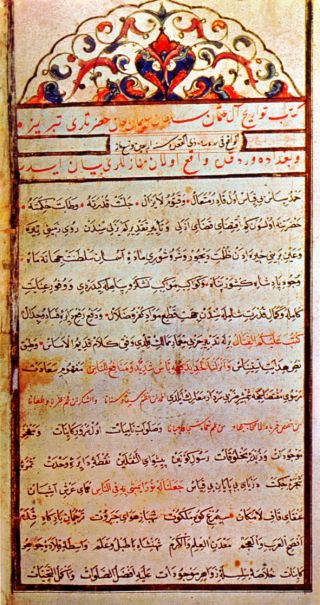
This work is not a classical art album or a compilation of miniatures. It is the visual inventory of the 16th-century Anatolian and Middle Eastern geography. Nasuh recorded the arduous route from Istanbul to Tabriz and from there to Baghdad with the precision of a cartographer and the sensitivity of a painter. In his drawings, “time” stands still; cities, fortresses, inns, and bridges are frozen in their state from centuries ago. Examining Nasuh’s work is like looking at the “youthful photographs” of ancient cities that today bear the fatigue of modern urbanism, concrete sprawl, and wars.
As Mirasium, in this article, we will not confine Matrakçı Nasuh merely to the label of “miniaturist”; we will delve deeply into his mathematical intellect, his discipline as a swordsman, and his vision as a “city documentarian.” For to understand his lines is not just to look at an artwork; it is to decode Anatolia’s cultural genetics and spatial memory.
I. SECTION: Portrait of a “Hezarfen” (Polymath)
When one speaks of the Renaissance man, Western figures immediately come to mind—Leonardo da Vinci, Michelangelo. There is a misconception that the concept of “Uomo Universale” (Universal Man), that is, an individual specialized in multiple disciplines with intellectual depth, is somehow unique to the West. Yet in 16th-century Istanbul, Matrakçı Nasuh, who had passed through the crucible of the Enderun school and was, in the literal sense, a “Hezarfen” (one of a thousand sciences/arts) through his intelligence and talents, is one of the brightest Eastern counterparts of this definition.
To understand Nasuh’s art, one must first understand how his mind worked. For he was not a romantic who picked up a brush and painted randomly; he was a rationalist who perceived the world through numbers, angles, and strategies. That famous “order” and “geometry” in his miniatures are, in fact, a reflection of his other two great identities: the mathematician and the swordsman.
Master of Numbers and Order: Nasuh the Mathematician
Long before he began to paint, Matrakçı Nasuh was a respected mathematician of his era. His works Cemâlü’l-Küttâb and Kemâlü’l-Hisâb (The Beauty of the Scribes and the Perfection of Calculation), written during the reign of Yavuz Sultan Selim, served as bedside books for the training of clerks in the Ottoman bureaucracy.
Nasuh’s mathematics was not merely theoretical abstraction; he saw mathematics as a practical tool for everyday life. He was among those who systematized, in the most comprehensible way of that period, the method known today in elementary schools or in computer algorithms as “lattice multiplication.” This method, which allows long and complex numbers to be multiplied without error within a grid system, is proof of the “grid” structure in his mind.
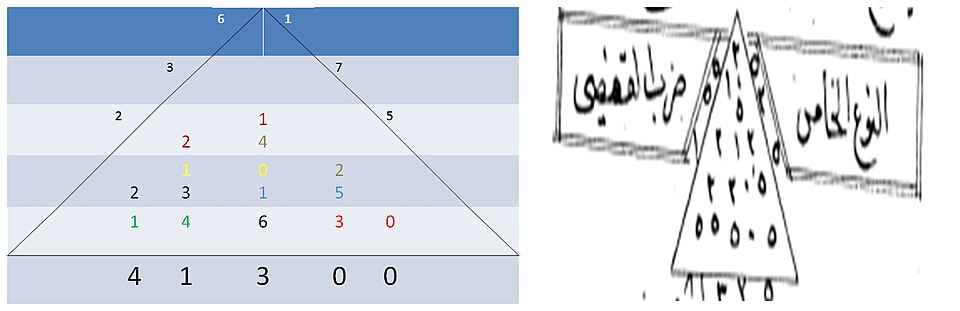
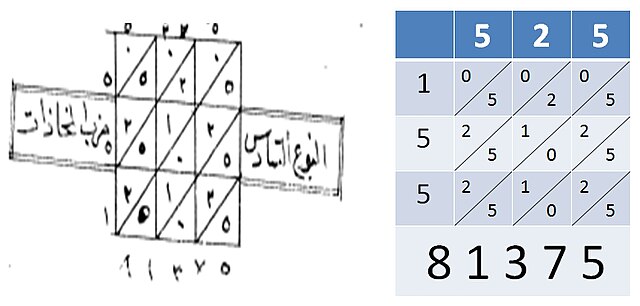
The difference between a mathematician’s gaze upon the world and that of a painter is this: the painter draws what he sees, while the mathematician draws “what ought to be” and the “ratio.” When you look closely at Nasuh’s miniatures, you immediately notice this mathematical infrastructure. When depicting cities, he does not scatter buildings randomly; he places them on a certain geometric plane with nearly the precision of an architectural plan. The arrangement of the fortress walls, the curvature of the domes, the height of the minarets… it’s as if they were all drawn with an invisible ruler. When Nasuh picked up the brush, he did not leave his mathematician identity in the vestibule; on the contrary, he carried it onto the canvas. His art is the marriage of aesthetics and arithmetic.
The Sword and Honor: Inventor of the “Matrak” Game
Nasuh’s nickname “Matrakçı” does not come from being a jester or a funny person, as is sometimes assumed, but from the “Matrak” game he personally invented, which revolutionized military training. Matrak is a kind of fencing/defense sport played with sticks made of boxwood, covered with soft cushions on the ends, and requiring extremely high conditioning and strategy.
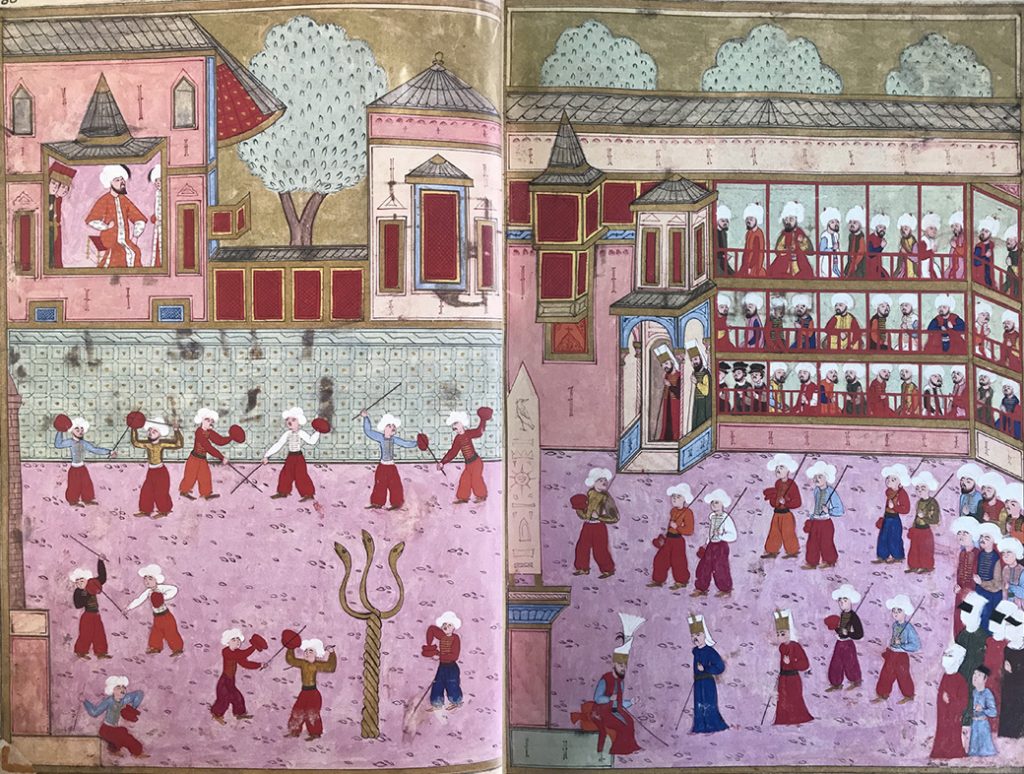
During the circumcision feast of Sultan Süleyman the Lawgiver’s sons (1530), Nasuh displayed his skills on the enormous stage set up in the Atmeydanı (Hippodrome), defeating his opponents one by one and was personally declared “Reis-i Hattatîn ve Üstad-ı Matrakî” (Chief of Calligraphers and Master of Matrak) by the Sultan through an edict dated 1529. This is a rare demonstration of physical prowess and honor for an artist.
A warrior’s eye sees geography differently than a painter’s. While a hill is “a beautiful landscape” to a painter, to a warrior that same hill is “a strategic point,” “a defensive line,” or “a watchtower.” This is the psychology underlying why Nasuh drew cities—especially fortresses and walls—so meticulously and solidly in his Sefer-i Irakeyn miniatures. He did not view the cities he drew merely as aesthetic objects; he analyzed them with a soldier’s eye, considering their defense mechanisms, entry and exit gates, and topographic advantages. The fortresses he drew are not decorative; they are “functional.”
A “Nonconformist” in the Palace Nakkaşhane (Painting Atelier)
- 16th-century Ottoman miniature art was largely under the influence of the Iranian (Herat and Tabriz) school. This school adopted an ornate, lyrical, mythological, brightly colored, and event-focused narrative. The crowded battle scenes, soaring angels, and stylized clouds we see in Shahname illustrations are the products of this school.
Matrakçı Nasuh, however, opened a completely different path right in the midst of this established tradition. In his works (especially in Beyan-ı Menazil), there are no people. Sultans, viziers, concubines, or heroes have withdrawn from the stage. The protagonist is the space itself. Nasuh broke away from the fairy-tale atmosphere of the palace atelier and adopted a “realistic” (documentarian) stance. He is not a storyteller; he is a topographer.
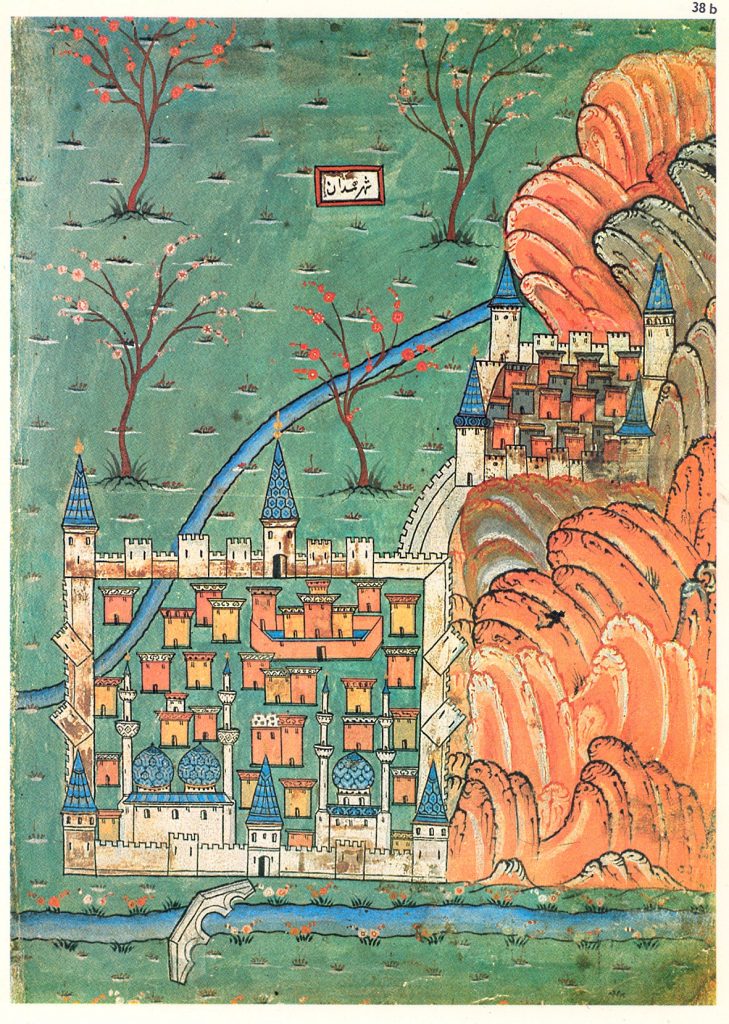
This preference for “dehumanization” is, in fact, an extremely modern approach. By removing the human figure, he focuses our attention on the buildings, nature, and the city itself. It is as if he is saying, “What matters here is not who lives here, but where this is and how it was built.” This attitude sharply distinguishes him from his contemporaries and opens a new chapter in art history called “Topographic Painting” or the “Matraki Style.”
He is a genius who calculated with his pen, fought with his sword, and recorded history with his brush. And now, it is time to embark on that great journey, the greatest masterpiece of this genius—the dusty roads of the Sefer-i Irakeyn.
II. SECTION: The Politics and Route of the Campaign
Works of art are not born in a vacuum; there is a painful historical context, a political necessity, or a desire for a show of force that gives birth to them. Matrakçı Nasuh’s Beyan-ı Menazil also sprouted right in the midst of one of the Ottoman Empire’s most turbulent and ambitious military operations, the “Sefer-i Irakeyn” (The Campaign of the Two Iraqs). Before turning the pages of this work, it is essential to understand under what conditions, on which dusty roads, and in what political climate those pages were drawn.
Two Giants, One Geography: The Conjuncture of 1533
By the early 1530s, world politics had turned into a chessboard of two superpowers squeezed between East and West. Sultan Süleyman the Lawgiver, struggling against the Habsburgs in the West, faced an increasingly restless neighbor on his eastern frontier: the Safavid State and Shah Tahmasp. Yet this was no ordinary border conflict. The stakes were the leadership of the Islamic world, sectarian tensions, and control of the Silk Road.
This campaign, initiated by the Ottoman Grand Vizier Pargalı Ibrahim Pasha as an advance force and joined later by Sultan Süleyman with an enormous army, was one of the most difficult logistical challenges in Ottoman history. The army setting out from Istanbul would cross Anatolia from end to end, traverse steep mountains, penetrate deep into Iran, capture Baghdad, and make a vast arc to return via Diyarbakır. The term “Irakeyn” (Two Iraqs) was given to the campaign because it encompassed both “Iraq-ı Arab” (Baghdad and its environs) and “Iraq-ı Acem” (Western Iran).
The Footprints of an Army
While looking at those elegant, colorful city depictions drawn by Nasuh, one must not forget the chaos and hardship behind these images. This work was produced not in an air-conditioned atelier but in tents, on horseback, sometimes in freezing cold, sometimes in scorching desert heat.
Nasuh was part of a massive crowd of over a hundred thousand soldiers, thousands of horses, camels, and cannons. He witnessed moments when wheels sank into mud, provisions ran out, and snow rose above a man’s height in the Bitlis mountains. Yet he did not reflect this pain and chaos in his work. His task was not to visualize the “hardship” of the campaign, but the “power” of the state and the “title deed” of the conquered lands. That is why there is no mud in his miniatures; every place is depicted as spotless, orderly, and in conformity with the order of the state. In this respect, Beyan-ı Menazil is not a war diary but a visual declaration of victory.
Why a Painting and Not a Map?
So, why did Sultan Süleyman the Lawgiver choose an artist like Matrakçı Nasuh for this task, rather than just a cartographer or a scribe? Because maps only show distance; pictures convey “ownership.” The Ottoman Empire was consolidating its legitimacy by recording the places it conquered or passed through not just with the sword but also with the pen.
Every city, every fortress, and every stopping point that Nasuh drew was a visual report sent to the capital. It is as if Nasuh says, “Here, my Sultan, are the roads we passed, the fortresses we took, the rivers from which we drank.” This work is an artistic zenith of the Ottoman bureaucracy’s obsession with record-keeping. While the accountants recorded the taxpaying population, Nasuh was recording the mountains, stones, and rivers into the visual memory of the state.
III. SECTION: A Break in Art History: The “Matraki” Style
Matrakçı Nasuh’s Beyan-ı Menazil is not only a historical document but also a “paradigm shift” in art history. Until the 16th century, certain patterns dominated Islamic miniature art (especially in the Iranian and Timurid tradition). Nasuh broke these patterns so radically that art historians had to give a special name to the style he created: the “Matraki Style” or “Topographic Painting.”
There are three fundamental elements that make this style revolutionary: Depopulation, Multiple Perspective, and Realism.
1. The Voice of Silence: Figureless Cities
When you first look at Nasuh’s miniatures, what strikes you is a profound “silence.” The cities are there, chimneys of houses emit smoke, fortress gates are open, gardens are well-kept, but there is no one around. No soldier, no merchant, no peasant…
This conscious preference for “dehumanization” sharpens Nasuh’s focus. If he had added people to the painting, the viewer’s attention would shift to the person’s clothing, action, or story. Nasuh, however, does not want attention to be dispersed. His protagonist is the space itself. He describes the city not with its temporary inhabitants but with its permanent structures. People are mortal, they die and go; but walls, mosques, and rivers endure. By erasing the temporary, Nasuh focused on the permanent—that is, on the “memory of place.” This capacity for abstraction is his most important feature that brings him close to modern architectural drawing techniques.
2. Centuries Before Cubism: Multiple Perspective
When drawing a city, Matrakçı Nasuh does not remain faithful to a single viewpoint (perspective). While Renaissance painters were occupied with the “vanishing point” and “single perspective,” Nasuh developed a technique that pushes the limits of perception.
He looks at the city simultaneously from the sky (bird’s-eye view) and from the ground (frontally).
- When drawing the outer walls of a fortress, he looks from the front (thus we see the height of the walls and the details of the gates).
- When he enters the fortress, he changes his viewpoint and looks from above (thus we see the layout of the mosque, bath, and houses inside).
This is a hybrid form of cartography and painting. Nasuh spreads the city out like a carpet and places the buildings on it like models. Thanks to this technique, the viewer can both read the city like a map (where to go, where is what?) and view it like a painting (what do the buildings look like?). This “flattened map” technique is a visual manifestation of Nasuh’s mathematical mind; he found the formula for transferring the three-dimensional world onto two-dimensional paper without any data loss.
3. Idealized Realism
Nasuh is realistic, yes. The mosque he draws is truly that mosque. The number of minarets, the dome form, its location are correct. Yet this is not “photographic” realism; it is “idealized” realism.
When drawing the city, Nasuh cleans up the “noise.” He does not include dilapidated shanties, street mud, or unaesthetic extensions in the painting. He depicts the most perfect state of the city “as it should be.” The buildings are always well-maintained, the trees always green, the waters always blue. This reflects the Ottoman perspective on the world: “In the lands we rule, there is order and harmony.”
Nasuh also ascribes symbolic meanings to colors. While tile and stone colors dominate in Anatolian cities (Konya, Diyarbakır), as one descends southward towards Aleppo and Baghdad, the color palette lightens, with sandy yellows and turquoise coming into play. In Iranian cities like Tabriz, under the influence of Safavid art, more ornate, purple, and pink tones are observed. This shows that Nasuh did not merely draw what he saw; he also analyzed the cultural codes of the geography through colors.
He reconstructed the visual language of the 16th century. And this new language invites us to that magnificent gallery of cities, the visual feast of Anatolia and the Middle East, which we shall examine in detail shortly.
IV. SECTION: The Visual Inventory of Anatolia and the Middle East
The theory is over; now it’s time to draw the curtain and look at the stage. When we turn the pages of Matrakçı Nasuh’s Beyan-ı Menazil-i Sefer-i Irakeyn, what we encounter is not just a “picture album” but a frozen slice of the 16th century. Let us look at the key cities along this route under Nasuh’s guidance, with his eyes—that is, through “The Eye of the Nakkaş (Painter).”
1. The Starting Point: The Perfect Silhouette of Dersaadet (Istanbul)
Nasuh opens the album with the heart of the empire, Istanbul. This depiction is considered the most comprehensive and detailed early-period map of Istanbul in art history literature.
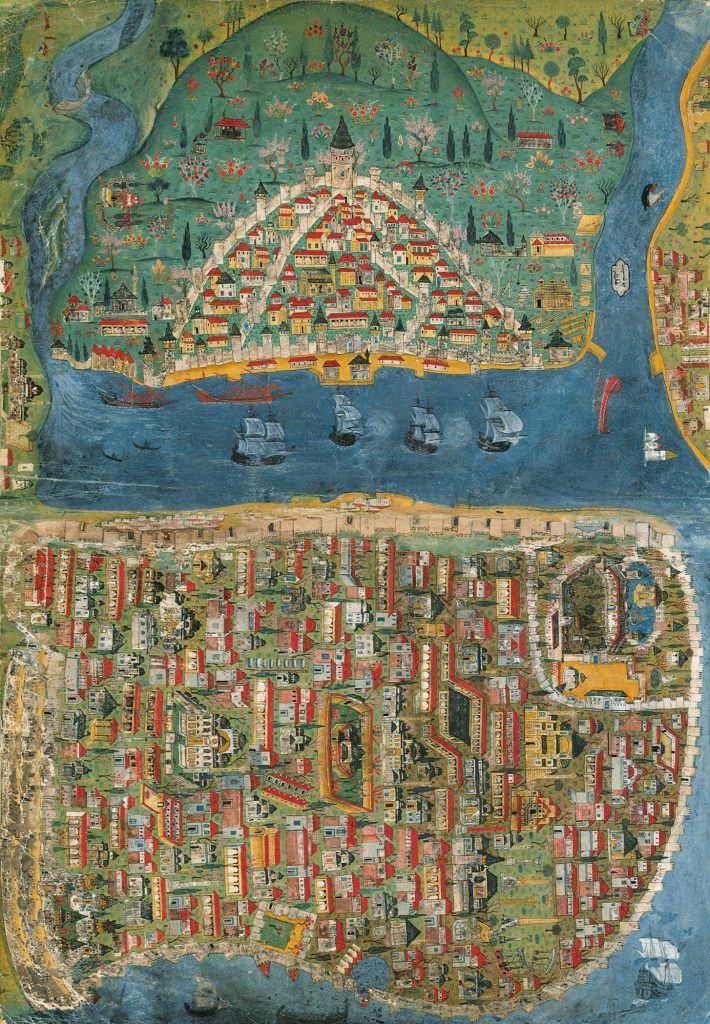
- The Golden Horn and Galata: Nasuh divides the page with the Golden Horn (Altın Boynuz). On the upper part lies Galata (Pera). At that time, Galata, bearing the Genoese heritage, is notable for its walled, dense, and vertical architecture. The Galata Tower, unlike what we know today, stretches skyward like a pointed cone with its conical roof.
- The Historical Peninsula: The lower part of the page contains the walled city of Istanbul. This is the grandeur of the state. Topkapı Palace, Hagia Sophia, Fatih Mosque, and the Atmeydanı (Hippodrome) are carefully arranged so as not to block one another. Here Nasuh uses an interesting color coding: he draws civilian buildings (houses) in paler, standard tones, while highlighting state buildings and mosques with vivid colors and golden gilding.
- Life in Details: Upon careful inspection, the cannons on the Tophane quay, sailing galleys floating on the Golden Horn, and the names of the city gates can be seen. Nasuh depicts the city not as a bundle of chaos but as a flawlessly functioning machine.
2. The Green Dome Amidst the Steppe: Konya
As the army advances into the interior of Anatolia, the geography yellows, the steppe begins. In his depiction of Konya, Nasuh reflects the city’s spiritual weight in its architecture.
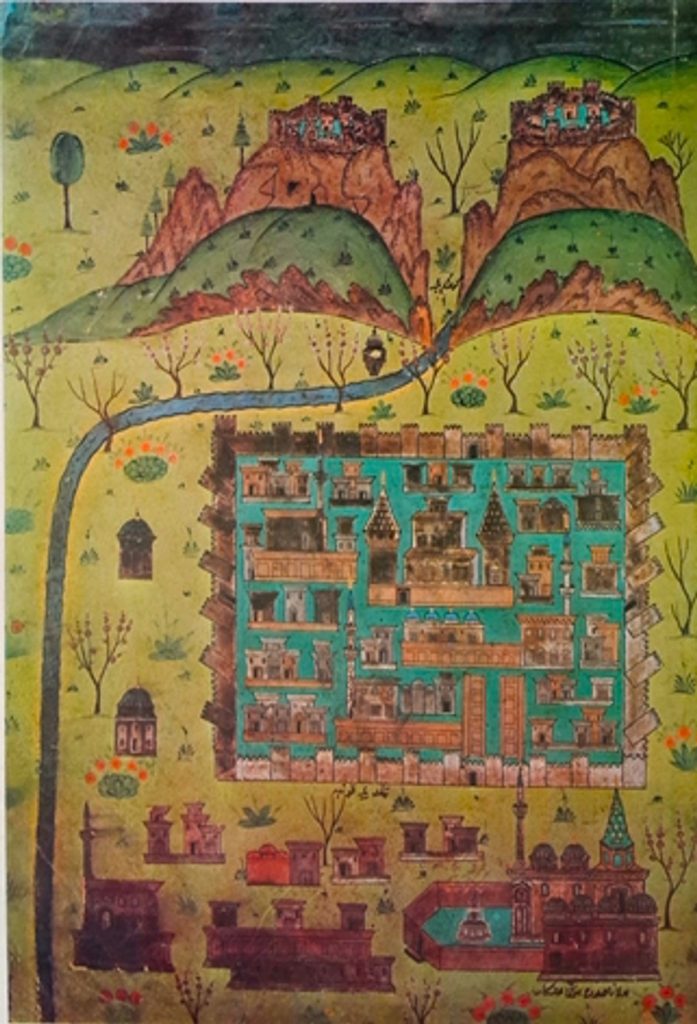
- The Mevlana Tomb: At the focal point of the miniature is the tomb of Hz. Mevlana and that famous “Kubbe-i Hadra” (Green Dome), which remains the symbol of the city today. By drawing the tomb larger and more centrally than the other structures of the city, Nasuh conveys the message, “Konya means Mevlana.”
- Walls and Moat: The walls surrounding the city and the external moats show Konya’s defense system of that period. The madrasas and mosques within the city reflect the characteristic features of Seljuk architecture: geometric stonework and pointed arches.
3. The Majesty of Black Stone: Diyarbakır
One of Nasuh’s most impressive depictions is undoubtedly Diyarbakır. The city is defined by its famous black basalt walls that stand almost like a shield.

- Black and Green: Nasuh paints the Diyarbakır walls in dark gray and black tones, conveying the hardness of the material (basalt stone). In contrast, he adorns the Hevsel Gardens right beside the walls and the banks of the Tigris River with vivid greens and fruit trees. This is the metaphor of “the paradise garden protected by hard stone.”
- The Inner Fortress: The life within the walls is layered. The Great Mosque is clearly discernible with its minarets and courtyard. The flat roofs of the houses document an architectural preference suited to the region’s climate (hot summers).
4. The Rugged Face of the East: Bitlis and Van
As one enters Eastern Anatolia, Nasuh’s lines become as rugged as the geography. There are no more flat plains; there are steep cliffs, valleys, and fortresses.
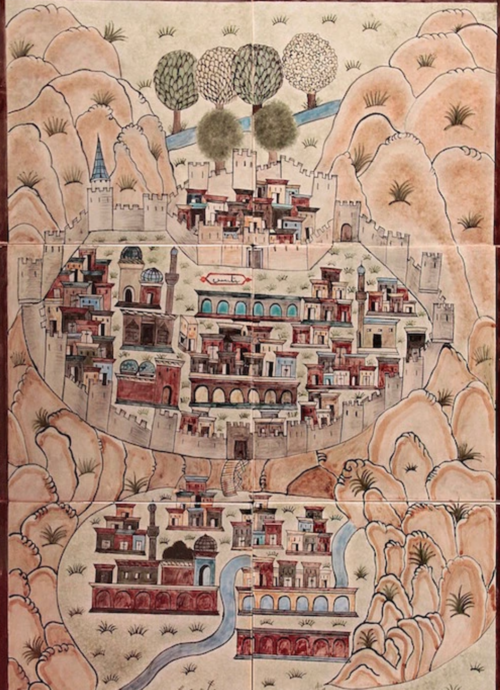
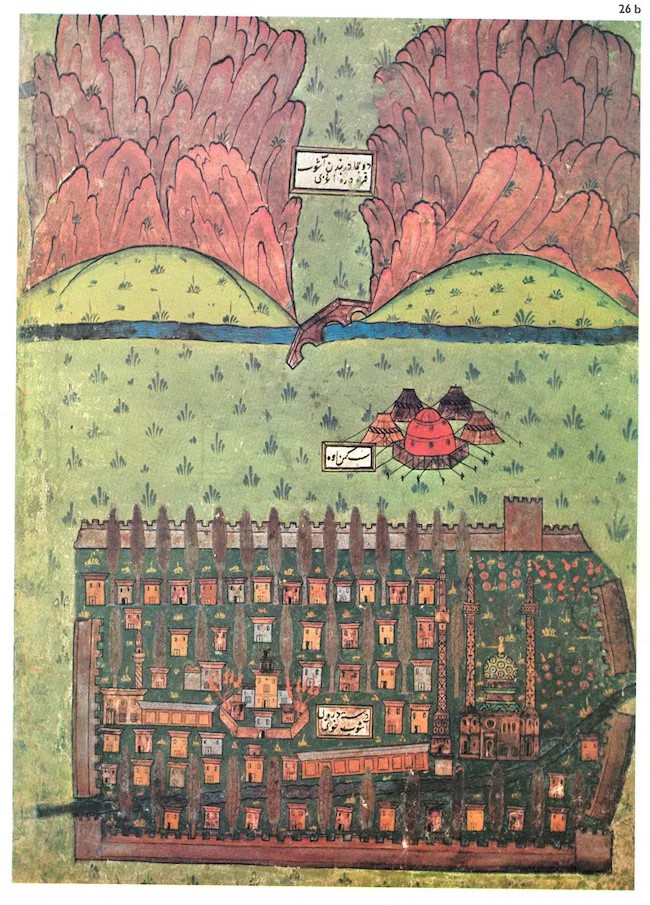
- Bitlis: Nasuh depicts Bitlis as a city squeezed between two mountains, built around a river flowing through the valley. The natural geography (mountains) and man-made structures (houses and bridges) are intertwined.
- Ahlat and Tombstones: In Ahlat along the way, he includes the famous Seljuk cemetery and kümbets (mausoleums). The detailed drawing of these tombstones is evidence that Nasuh respected not only living cities but also cultural heritage.
5. The Stopping Points: Aleppo and Baghdad
When borders are crossed and one descends southward, the climate and vegetation change. Nasuh shows this change with palm trees and the differentiation in building materials.
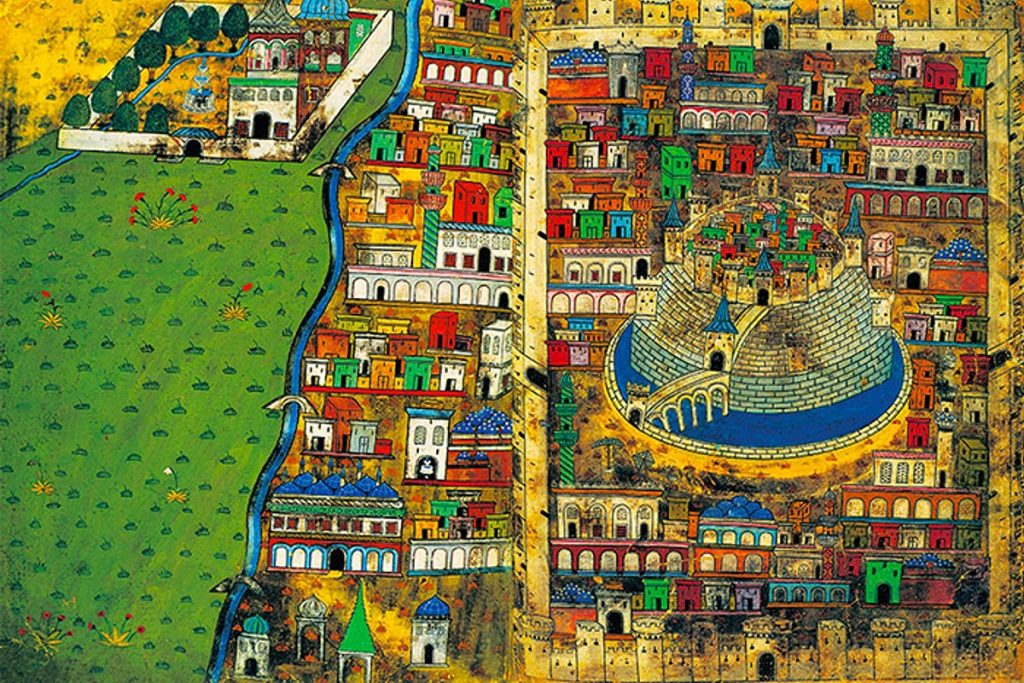
Source: Matrakçı Nasuh, Beyan-ı Menazil (1537).
- Aleppo: The Aleppo Citadel stands like an unassailable monument atop a massive hill. The famous bridged entrance of the citadel gate reveals Nasuh’s interest in military architecture.
- Baghdad and Sacred Sites: In the Baghdad depictions, “water” (the Tigris and Euphrates) and “shrines” (Imam al-A‘zam, Karbala, Najaf) are prominent. Nasuh visualizes the reverence for these sacred sites by painting their domes in gold gilding. The architecture here differs from Anatolia; ornamentation has increased, and the use of tiles has intensified.
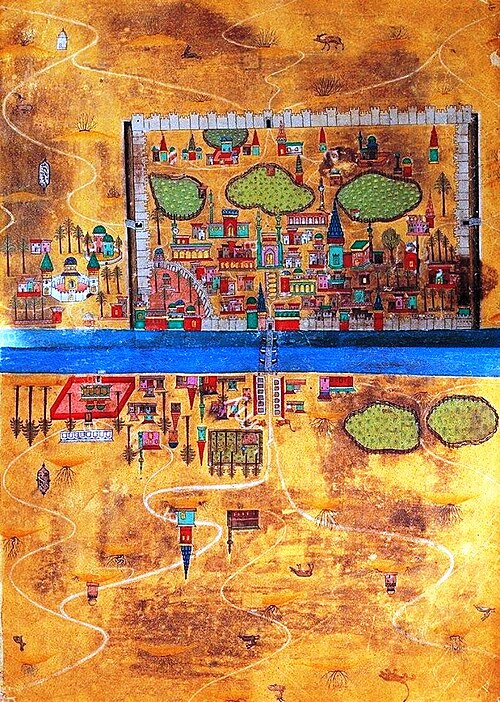
Source: Matrakçı Nasuh, Beyan-ı Menazil (1537).
CONCLUSION: The Difference Between Seeing and Looking
When Matrakçı Nasuh closed his eyes for the last time in 1564, he left behind not just mathematics books or battle tactics. He built the “visual memory” of an empire. Today, as we look at his drawings from the digital screens of the 21st century, we do not merely see old buildings.
- Like a City Planner, we observe the development of cities over the centuries.
- Like an Architect, we analyze the original forms of lost structures.
- Like a Historian, we read the political power of 1533 and the frontiers the state reached.
Nasuh’s Beyan-ı Menazil is like a manifesto that directly aligns with the raison d’être of the “Mirasium” project. He added the principle “Painting preserves” to the maxim “Words fly, what is written remains.” Today, when we look at the Diyarbakır walls, the Galata Tower, or the Konya Plain; if we can feel the historical depth there, the legacy left by “seeing eyes” like Nasuh’s has a great share in it.
In the caravan of those who narrate the ancient story of Anatolia, Matrakçı Nasuh is one of the foremost riders. It has been 500 years since his brush dried, but the colors he painted are still fresh and alive in the digital memory of Mirasium.
Where words end, Matrakçı’s colors begin. Browse the gallery below to examine all miniatures in detail.
BIBLIOGRAPHY AND FURTHER READING SUGGESTIONS
1. Fundamental Works (Books)
- Atasoy, Nurhan.Matrakçı Nasuh ve Menazilnâmesi [Matrakçı Nasuh and His Menazilnâme]. İstanbul: MASA Publications, 2015.
- (Note: This is the most comprehensive work written on the subject. It includes facsimile reproductions of the miniatures.)
- Yurdaydın, Hüseyin G.Nasûhu’s-Silâhî (Matrakçı) ve Beyân-ı Menâzil-i Sefer-i Irâkeyn [Nasûhu’s-Silâhî (Matrakçı) and the Description of the Stages of the Campaign of the Two Iraqs]. Ankara: Turkish Historical Society (TTK) Publications, 1976.
- (Note: This is the fundamental reference for biographical information.)
2. Articles and Book Chapters
- Kahraman, Seyit Ali. “Beyan-ı Menazil’in Metin Transkripsiyonu ve Değerlendirmesi” [Textual Transcription and Evaluation of Beyan-ı Menazil]. In Matrakçı Nasuh ve Menazilnâmesi. İstanbul: MASA Publications, 2015.
- Çakmut, Feza. “Matrakçı Nasuh’un Minyatürlerinde Kale ve Şehir Betimlemeleri” [Depictions of Castles and Cities in the Miniatures of Matrakçı Nasuh]. In Matrakçı Nasuh: 16. Yüzyıl Dahisi [Matrakçı Nasuh: A 16th Century Genius] (Ed. Beste Gürsu). İstanbul: İKASD Publications, 2016.
- Pekin, Ersu. “Matrakçı Nasuh”. TDV İslâm Ansiklopedisi [TDV Encyclopedia of Islam], Vol. 28, pp. 143-145. Ankara: TDV Publications.
3. Digital Archives and Libraries
- Istanbul University Rare Works Library: Beyan-ı Menazil-i Sefer-i Irakeyn (Inventory No: T. 5964).
- The Public Domain Review: “The Maps of Matrakçı Nasuh” Digital Collection.
⚖️
License and Copyright Notice
Media usage rules
Check the license/copyright information for all media files (images, videos, audio, documents, etc.) included in this content from the relevant work descriptions.
📚 Read the Terms and Conditions