

A Masterpiece from Word to Image: Siyer-i Nebi
Uncover the story of Siyer-i Nebi, the magnificent 1595 Ottoman manuscript depicting the life of Prophet Muhammad. Learn about its unique iconography, dispersed volumes, and the artists who created it.
INTRODUCTION: SIYER-I NEBI AS AN IMPERIAL PROJECT
The final quarter of the 16th century, when the Ottoman Empire was at the zenith of its political and military power yet social and economic fluctuations had begun to be felt, marks a unique period in terms of artistic patronage. Sultan Murad III (r. 1574–1595), unlike his grandfather Süleyman the Magnificent, was a ruler who focused more on cultural and intellectual life at the court than on military campaigns. The most concrete and magnificent fruit of this intellectual atmosphere is the illustrated manuscript known today in art-historical literature as “Siyer-i Nebi”, narrating the life of the Prophet Muhammad (pbuh).
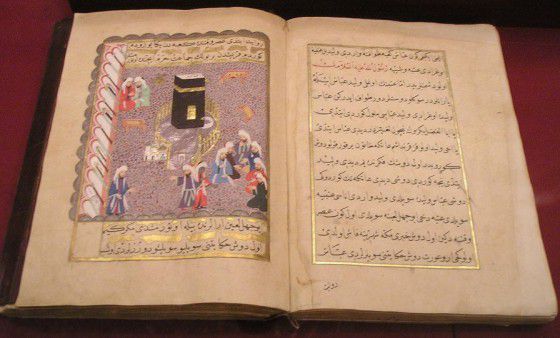
The main feature that distinguishes this work from others is that it is the most comprehensive visual biography in the history of Islamic art. Conceived as a total of 6 volumes and containing 814 miniatures (a smaller number survive today), this project is not merely the illustration of a religious text; it is a visual archive documenting the Ottoman worldview, aesthetic sensibility, and reverence for the “sacred.”
CHAPTER 1: THE ORIGIN OF THE TEXT AND HISTORICAL BACKGROUND (1388 – CAIRO)
Although the illustrations belong to the 16th century, the text that forms the spirit of Siyer-i Nebi dates back much earlier, to the 14th-century Mamluk court. To make sense of the images, one must first understand the author of the text and his purpose in writing it.
1.1. Mustafa Darir of Erzurum and the Vision of the “Blind” Poet
The text of the work was penned by Mustafa ibn Yusuf, originally from Erzurum and referred to in sources by the epithet “Darir” (sightless, blind). Mustafa Darir went to Egypt in 1377 and entered the court of the Mamluk Sultan al-Malik al-Mansur Alaaddin Ali, and subsequently that of Sultan Barquq.
Mamluk Sultan Barquq asked Darir to compose a Turkish work narrating the life of the Prophet (pbuh) in a simplicity that everyone could understand. Drawing on Arabic sources (especially the sīra works of Ibn Ishaq and Ibn Hisham, and the writings of Abu’l-Hasan al-Bakri), Darir reinterpreted them in a fluid, mixed prose-and-verse (poetry and prose) style rather than a dry translation.
The writing was completed in the year 1388 (AH 790). That Darir was a “sightless” author adds an ironic and miraculous depth to the descriptive power of the work. Centuries later, Ottoman painters would transform the words of a writer who could not see into a magnificent visual feast for seeing eyes.
CHAPTER 2: THE 1595 INITIATIVE AND THE PALACE ATELIER
Mustafa Darir’s text was read and loved in Anatolia and court circles for centuries. However, the transformation of that text into a monumental work of art would require the command of Sultan Murad III.
2.1. The Threshold of “AH 1000” and the Expectation of the End Times
Art historians argue that behind Murad III’s initiation of this colossal project lay not only artistic taste but also the “apocalyptic expectation” of the period. As the 1000th year of the Hijri calendar (1591–92 CE) approached, a sense of renewal (tajdīd) or expectation of the end times prevailed in the Islamic world. Sultan Murad III may have sought both to prove his own piety and to attain the intercession of the Prophet by having his life depicted down to the smallest detail.
2.2. Nakkaş Osman and His Team
The visual direction of the project was entrusted to the head of the court painters (Ser-Nakkaş) Lütfi Abdullah (some sources indicate he was at the head of the project) and the master Nakkaş Osman, who defined the style. Nakkaş Osman is considered the founder of the classical Ottoman miniature style. Along with the court historiographer Seyyid Lokman, he produced many historical works, and in the Siyer-i Nebi project he had to create a “realistic yet sacred” visual idiom.
This project was too vast to be executed by a single person. Payment records in the palace archives (Ehl-i Hiref registers) show that a large team worked under Nakkaş Osman’s leadership. While Nakkaş Osman designed the main compositions and the important figures (such as the Prophet), his pupils and other painters in the workshop completed the landscapes, crowd scenes, and architectural details.
CHAPTER 3: ICONOGRAPHY AND THE AESTHETICS OF “ADAB” (VISUAL LANGUAGE)
How did an Ottoman artist depict the Prophet in a religion that prohibits figural representation? The answer lies in the aesthetics of “abstraction and concealment”.
3.1. The Concealment of the Face: The White Veil (Niqāb)
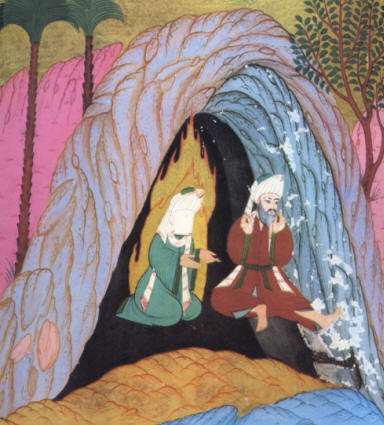
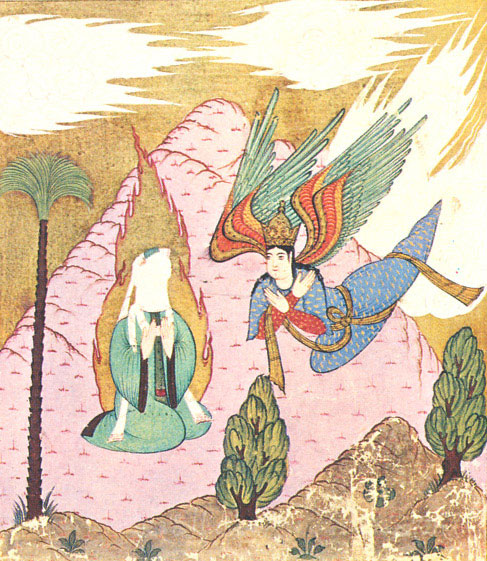
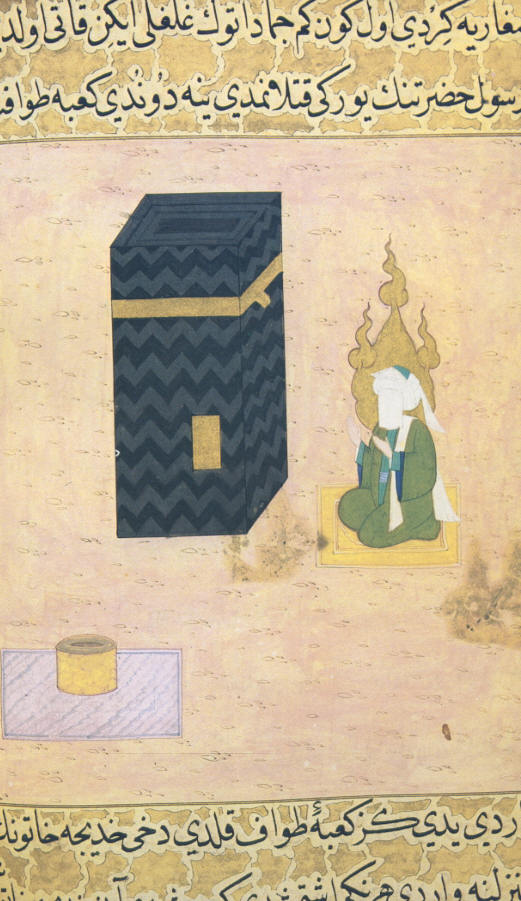
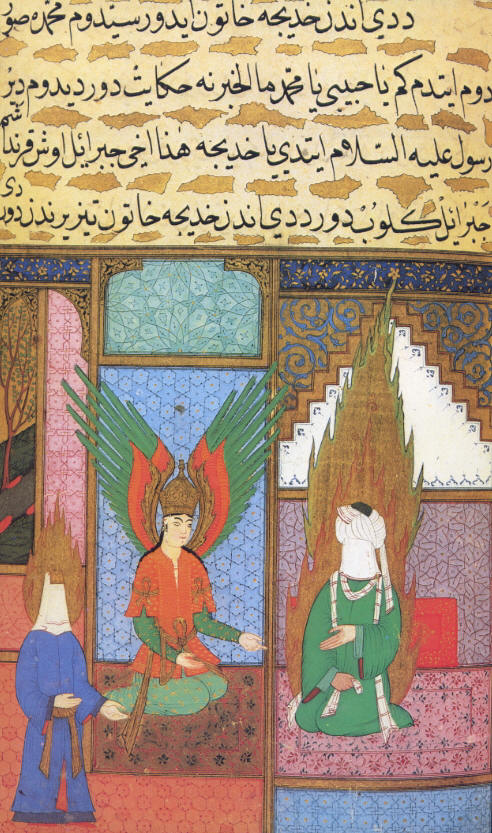
In all the miniatures of the Siyer-i Nebi, the Prophet Muhammad (pbuh) is depicted with a white veil over his face.
- Meaning: This veil does not deny the physical reality of the Prophet; it emphasises that his beauty and his light (nūr) are too sublime to be perceived by mortal eyes.
- Artistic Function: The veil ensures that the viewer’s attention is focused not on “facial expression” (the human) but on the figure’s posture and spiritual presence (the divine).
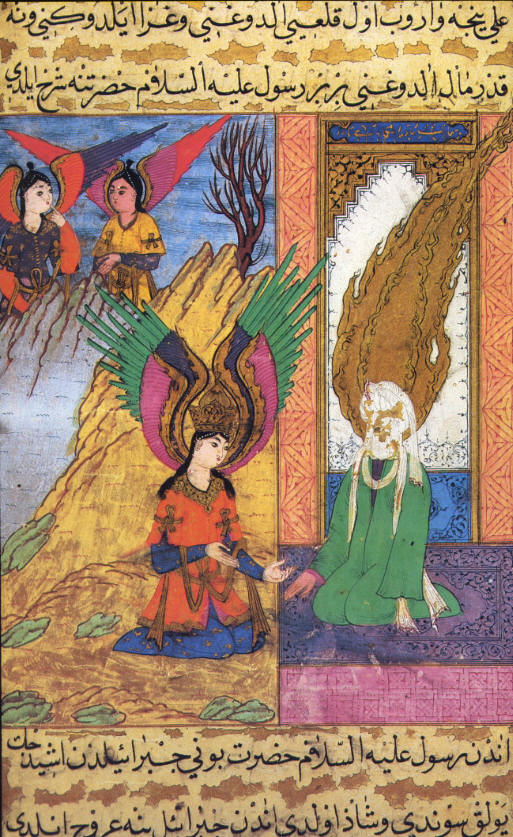
3.2. The Light of Prophethood: The Flame Halo
In Western art (Byzantine and Renaissance), the haloes around the heads of saints are usually in the form of a “circle/disk.” In the Siyer-i Nebi, however, the haloes around the head of our Prophet and other prophets are in the form of a flame/fire.
- Origin: This form passed into Islamic art from Uyghur-Buddhist art and the Persian miniature tradition.
- Symbolism: It represents the concept of “nūr” (light), that is, illumination and enlightenment. This flame is sometimes drawn large enough to envelop the entire body of the figure.
3.3. The Turkification of Place and Time
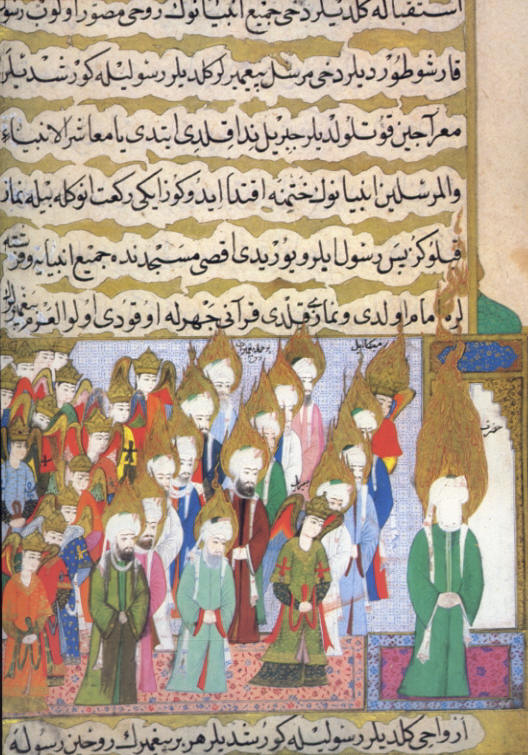
Although the events take place in the 7th-century Arabian Peninsula (Mecca, Medina), Nakkaş Osman depicted the settings as 16th-century Istanbul architecture.
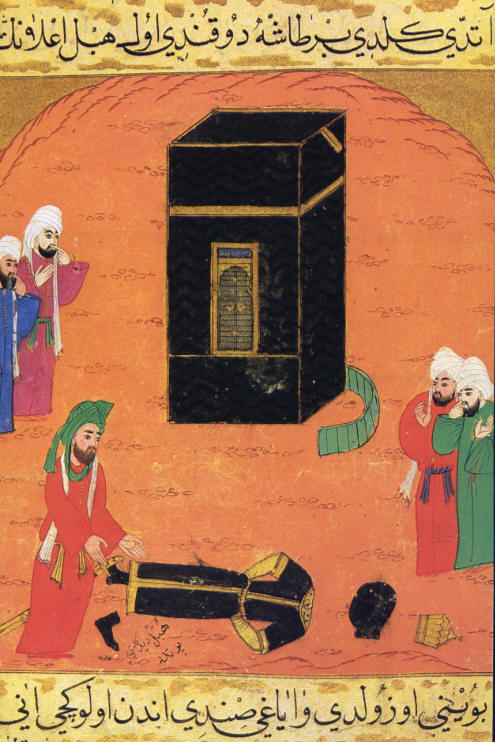
- The depictions of the Kaaba reflect the Kaaba covers of the Ottoman period.
- In interior scenes, İznik tiles, Ottoman carpets, and cushioned seating (sedir) are visible.
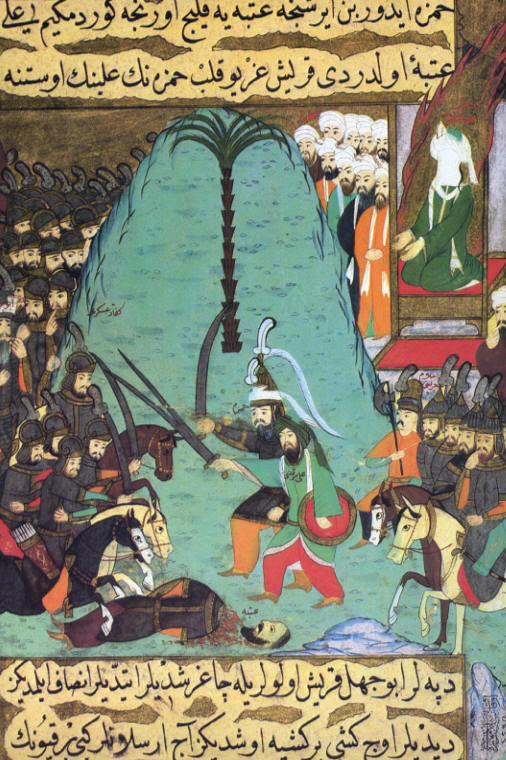
- The Companions and soldiers accompanying the Prophet are clothed in the manner of Ottoman sipahis and janissaries.
- Why? This is not a mistake, but a conscious choice. By transporting the Prophet into his own time and space, the artist aimed to make him feel “one of us” and to heighten the impact on the viewer by making the event contemporary.
3.4. Other Figures
- The Four Rightly Guided Caliphs: They are usually depicted right next to the Prophet. Imam Ali can generally be distinguished by his sword “Dhū’l-Faqār.”
- Angels (Gabriel): Angels are depicted with colourful wings, magnificent garments, and in human form (but genderless/with a youthful male beauty).
- Satan and Idols: Satan is usually depicted as a dark-skinned, hairy, horned, grotesque figure; idols are portrayed as crumbling, helpless statues.
CHAPTER 4: THE SIX VOLUMES AND THEIR CURRENT STATUS (LOST HERITAGE)
When the work was completed (around 1595), Sultan Murad III had passed away or was on the verge of doing so; therefore, it was presented to his son Mehmed III. Consisting of a total of 6 volumes, the work left the Ottoman treasury over the centuries and became dispersed. The fate of these volumes is as follows:
- Volume I (Hazine 1221):
- Location: Topkapı Palace Museum Library (Istanbul).
- Content: The birth of Prophet Muhammad, his childhood, the first revelation.
- Condition: It is in Turkey and is one of the best-preserved volumes.
- Volume II (Hazine 1222):
- Location: Topkapı Palace Museum Library (Istanbul).
- Content: The early years of Islam, the migration to Abyssinia (Hijrah to Habasha), the conversion of Hamza and Umar to Islam.
- Volume III (Spencer Collection, Cat. no 157):
- Location: New York Public Library (USA).
- Content: The Mi‘raj (Ascension) event, preparations for the Hijrah. The Mi‘raj miniatures (Burāq, the celestial spheres, depictions of heaven and hell) are especially unique from an art-historical perspective.
- Volume IV (T 419):
- Location: Chester Beatty Library (Dublin, Ireland).
- Content: The Medinan period, the battles of Badr and Uhud. This is the volume with the most intense battle scenes.
- Note: How this volume ended up there is not entirely known, but it is thought to have been sold in the 19th or early 20th century.
- Volume V (Lost / Dispersed):
- Condition: The integrity of this volume has been disrupted. Some of the miniatures it contained were cut out and sold to different collections, museums, or private individuals. It is one of the greatest losses in art history.
- Volume VI (Hazine 1223):
- Location: Topkapı Palace Museum Library (Istanbul).
- Content: The conquest of Mecca, the Farewell Pilgrimage, the passing of the Prophet. This is the end of the work.
CHAPTER 5: WHY IS IT IMPORTANT? (CONCLUSION AND EVALUATION)
Siyer-i Nebi is not merely “pictures made long ago.” The significance of this work for the Mirasium project lies in the following:
- A Visual Perception of the Sunnah: This work is evidence of how the Ottoman people imagined the Prophet. The Prophet is not one to be feared but one to be longed for; a guide whose face cannot be seen, yet by whose light one is illuminated.
- Documentary Value: The armours, tents, swords in the battle scenes, and the carpets and tiles in the palace scenes are a faithful copy of 16th-century Ottoman material culture. A historian can analyse the military order of the period by looking at these pictures.
- Artistic Synthesis: It is a masterpiece in which Central Asian, Persian, and Ottoman styles merge, yet the “Istanbulite” character predominates.
As you examine these images we exhibit at Mirasium, we hope you will feel the triad of “adab” (decorum), “patience,” and “faith” behind every brushstroke. In trying to depict paradise, Nakkaş Osman and his nameless assistants in fact poured the faith within their own inner worlds onto the page.
Explore the gallery below to examine all miniatures in detail.
BIBLIOGRAPHY
The information presented in this article has been compiled from the primary reference works whose bibliographic details are given below.
- Tanındı, Zeren. (1984). Siyer-i Nebî: İslam Tasvir Sanatında Hz. Muhammed’in Hayatı [Siyer-i Nebi: The Life of Prophet Muhammad in Islamic Figural Art]. İstanbul: Hürriyet Vakfı Yayınları. (Note: This work is the foundational book on the subject. It is the primary source for the locations of the volumes and their miniature contents.)
- And, Metin. (2014). Osmanlı Tasvir Sanatları: 1 Minyatür [Ottoman Figural Arts: 1 Miniature]. İstanbul: Yapı Kredi Yayınları. (Note: Used for the general characteristics of Ottoman miniature, the style of Nakkaş Osman, and East-West comparisons.)
- Çağman, Filiz & Tanındı, Zeren. (1979). Topkapı Sarayı Müzesi İslam Minyatürleri [Islamic Miniatures of the Topkapı Palace Museum]. İstanbul: Tercüman Sanat ve Kültür Yayınları. (Note: Referred to for technical analyses of the volumes in the Topkapı Palace.)
- Bağcı, Serpil; Çağman, Filiz; Renda, Günsel; Tanındı, Zeren. (2006). Osmanlı Resim Sanatı [Ottoman Painting]. Ankara: Kültür ve Turizm Bakanlığı Yayınları. (Note: The historical background of the project, the Murad III period, and information on the nakkaşhane organisation are drawn from here.)
- Fisher, Carol Garrett. (1984). The Pictorial Cycle of the Siyer-i Nebi: A Late Sixteenth-Century Manuscript of the Life of Muhammad. PhD Dissertation, Michigan State University. (Note: Consulted for iconographic analysis of the work and for scholarly findings on the origin of symbols such as the flame halo and the veil.)
- İpşiroğlu, Mazhar Şevket. (1973). İslam’da Resim Yasağı ve Sonuçları [The Prohibition of Images in Islam and Its Consequences]. İstanbul: Yapı Kredi Yayınları. (Note: Used for the theoretical framework regarding the prohibition of figural representation and the resultant artistic solutions (abstraction).)
⚖️
License and Copyright Notice
Media usage rules
Check the license/copyright information for all media files (images, videos, audio, documents, etc.) included in this content from the relevant work descriptions.
📚 Read the Terms and Conditions