

Turquerie: The 18th-Century European Craze for Ottoman Art, Fashion, and Music
Explore the Turquerie movement that captivated 18th-century Europe, turning Ottoman-inspired fashion, art, music, and coffee rituals into symbols of refinement. Discover how diplomatic visits, Lady Montagu’s letters, and master painters reshaped the West’s fascination with the East.
Introduction: The Transformation of Fear into Aesthetics
Historical narratives often begin on battlefields and end at treaty tables. Yet cultural history is a silent process of interaction that commences where wars conclude. For centuries, the Ottoman Empire, encoded as the “Antichrist” or the “Barbarian” in the collective subconscious of Christian Europe, underwent a surprising identity shift at the dawn of the 18th century.
This transformation began when Ottoman military power was checked by the Treaty of Karlowitz (1699). As the danger receded, curiosity surfaced. The philosophers and artists of the European Age of Enlightenment began to see the East not merely as an enemy, but as an alternative civilizational basin to be studied, even imitated. It was this curiosity that gave birth to the Turquerie movement, which was born in France and would sweep across the entire continent.
This movement is distinctly separated from the colonialist and othering “Orientalism” of the 19th century. Turquerie was a naïve admiration, a fantastic escape, and a desire to take refuge in the “comfort” of the East from the rigid social rules of the West (such as the tight corsets for women).
Chapter I: A Diplomatic Theater and a Turkish House in Paris
The sociological explosion point of the Turquerie movement was the shock waves created by diplomatic visits. Ottoman envoys brought not only the sultan’s letters to European capitals but also the “stage show” of the East.
The Incident of Müteferrika Süleyman Ağa (1669)
The Paris visit of Mehmed IV’s envoy Müteferrika Süleyman Ağa was followed with an interest that could be considered the precursor of the modern tabloid press. While King Louis XIV (the Sun King) attempted to overshadow the Ottoman envoy by having his throne plated with silver and appearing before him covered in diamonds, Süleyman Ağa’s simplicity and self-confidence wrong-footed the French court.
However, the real impact occurred after the official reception. The mansion where Süleyman Ağa stayed in Paris turned into a veritable theater stage. Parisian aristocratic women were devising excuses to see this mysterious Turk. One of the witnesses of the period, d’Arvieux, describes those days as follows:
“The Ağa’s room always smelled of musk and ambergris. The carpets on the floor, the fabrics on the walls, and the presentation of coffee, a beverage we had never seen before… It was all like a spell. The ladies swarmed around the Ağa like moths.”
This visit inspired Molière’s famous play Le Bourgeois Gentilhomme. Although the play satirizes Turkish ceremonies, it essentially confirmed the French obsession with the Turks.

Yirmisekiz Çelebi and the Birth of Rococo
In 1721, the Paris visit of Yirmisekiz Çelebi Mehmet Efendi inaugurated the “golden age” of Turquerie. Çelebi was not just a diplomat but an intellectual. Every invitation he attended with his son Said Efendi and every kaftan he wore sparked a new trend in French fashion. So much so that the French painter Charles Parrocel immortalized this visual feast by depicting the ambassadorial procession frame by frame. During this period, wearing “hair styled à la turque” and “kaftan-like morning gowns (robe à la turque)” became a status symbol among French court ladies.

Chapter II: Lady Montagu and the True Face of the Harem
The person who took the Turquerie movement beyond being a mere male fantasy and endowed it with intellectual depth was an English aristocrat: Lady Mary Wortley Montagu.
The wife of the British Ambassador to the Ottoman Empire, Lady Montagu arrived in Istanbul in 1717 and bore witness to a place no man could ever enter: the Ottoman Harem and the bathing pleasures of Turkish women. The letters she wrote to her friends, later published as Turkish Embassy Letters, demolished the image of the “captive Turkish woman” in Europe.
Lady Montagu wrote that Turkish women were far freer than their European counterparts, enjoyed property rights, and could stroll the streets as they wished by concealing their identities thanks to the “ferace.” In an era when European women could hardly breathe in their corsets, the “Turkish salvar” and comfortable attire described by Montagu became a symbol of freedom for Western women.
In a letter, Montagu said:
“Here, women enjoy far more respect and possess much more freedom than we ever imagined. It is impossible not to envy their grace and comfort.”
These letters laid the foundation of “realistic Turquerie” by inspiring the works of painters such as Jean-Étienne Liotard.

Chapter III: The Dream on Canvas – Turquerie Through the Eyes of Painters
Eighteenth-century painting was shaped by nobles having themselves portrayed not as mythological heroes but as “Sultans of the East.” This was more than a costume party; it was an “image-making exercise” demonstrating one’s intellectual accumulation and openness to the world.
1. Jean-Baptiste Vanmour: The Documentary Approach
The artist who best documented Tulip Era Istanbul is undoubtedly Vanmour. Arriving in Istanbul with the French ambassador and living there until the end of his life, Vanmour painted everything from the sultan’s audience ceremonies to the Patrona Halil Rebellion. His 100-plate collection “Recueil de cent estampes representant differentes nations du Levant” (A Collection of 100 Engravings Representing the Different Nations of the Levant) became the reference book for all tailors, decorators, and painters in Europe. Most of the images that come to mind today when we think of “Turkish costume” are from Vanmour’s hand.
2. Carle van Loo and Madame de Pompadour
When Louis XV’s mistress Madame de Pompadour posed for the painter Carle van Loo to emphasize her power and intellectual refinement, she conformed to the fashion of the day by appearing dressed as a ‘Haseki Sultan.’ In the painting, Pompadour is seen not amidst a crowded harem scene but in a quite intimate and comfortable corner, reclining on her divan. While accepting coffee offered by a black concubine, she enacts the ‘pleasure’ ritual of the East with the long pipe (chibouk) she holds in her other hand. This composition transforms the Ottoman woman from a mere ‘object of the gaze’ into a noble figure savoring luxury and refined pleasures.
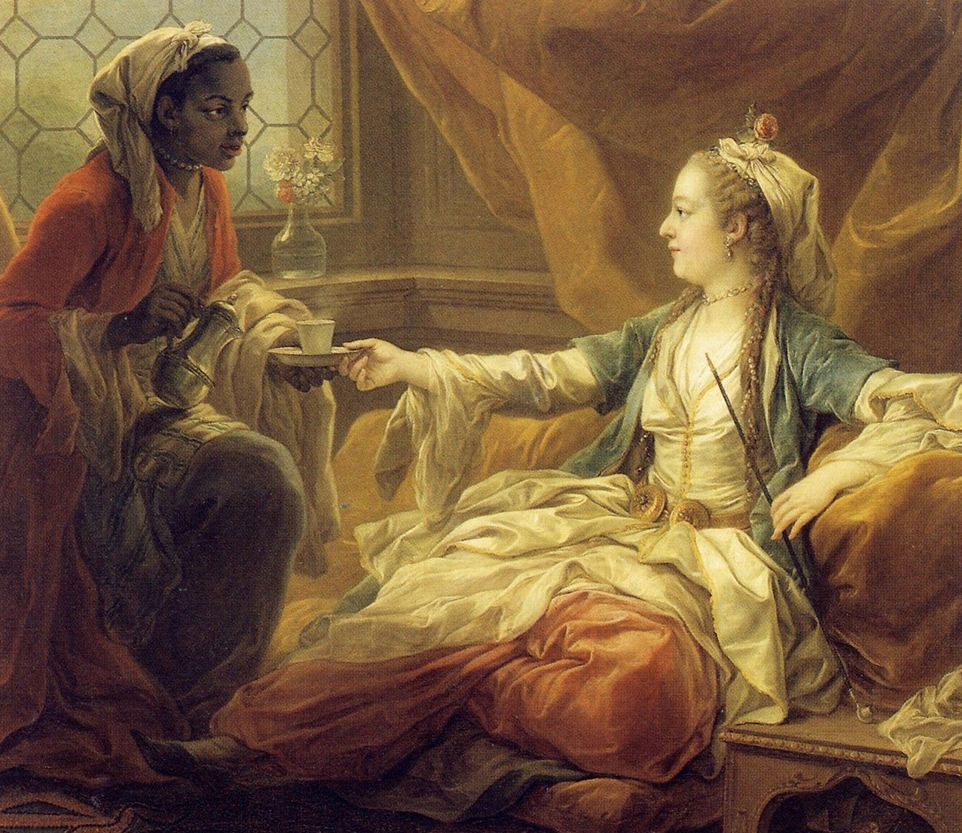
3. Jean-Étienne Liotard: “The Bearded Turk”
The Swiss painter Liotard is the most eccentric figure of this movement. He lived in Istanbul for five years, learned Turkish, and upon returning to Europe refused to shave his beard or take off his robe. Wandering the streets of London and Vienna like an Ottoman, Liotard reflected not “Orientalist fantasy” in his pastel portraits but the texture of the fabric, the simplicity of light, and the serenity of the East.

Chapter IV: Alla Turca – The Rhythm of Music Changes
Beyond the visual arts, Turquerie also appealed to the ears. European armies had noticed the psychological impact of the Ottoman Janissary Band (Mehter Takımı) on the battlefield. The boom of the kettledrums, the sharp sound of the cymbals, and the rhythm of the çevgan filled the “percussion” deficiency in Western music.
This trend, which entered music terminology as “Alla Turca” (Turkish style), influenced the greatest geniuses of classical music:

- Mozart’s Turkish Passion: In his opera Die Entführung aus dem Serail (The Abduction from the Seraglio), Mozart “Turkified” not only the music but also the subject. In the opera, Pasha Selim is portrayed not as a cruel tyrant but as a forgiving and magnanimous ruler. This is the “Virtuous Turk” image of the Age of Enlightenment. The famous Rondo alla Turca (Turkish March) is the rhythmic structure of the mehter adapted to the piano.
- The “Janissary Pedal” on the Piano: Some pianos produced in the late 18th and early 19th centuries featured a special “Janissary Stop” that produced drum and cymbal sounds. This is the most concrete evidence that the fashion for Turkish music extended to instrument manufacturing.
Chapter V: Material Culture – Coffee, Tulips, and Turquoise
Turquerie advanced not only through art but also through the objects of daily life.
- Coffee Ceremonies: Although coffee entered Europe through Venetian merchants and after the Siege of Vienna, it was thanks to Turquerie that it became an “aristocratic beverage.” Drinking coffee turned into a ceremony with special porcelain cups, ibriks (coffee pots), and accompanying sweets. The Meissen porcelain factory responded to this demand by producing “Turkish-style” cups.
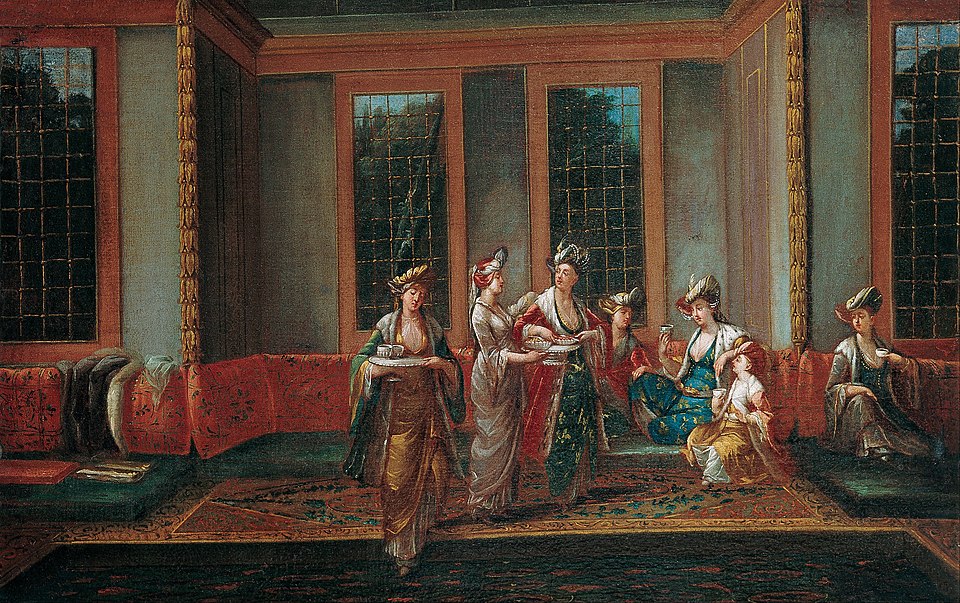
- Turquoise (Turkuaz): This word, meaning “Turkish stone” in French, entered the lexicon when the turquoise stone coming from Ottoman lands became fashionable in European jewelry.
- Furniture and Decoration: The concepts of the “Sofa” and “Divan” entered European homes. Low couches supported by cushions, called “Ottomane” in French furniture art, took pride of place in salons. Boudoirs (women’s private rooms) were decorated with Turkish carpets and hookahs in an attempt to create a “little Istanbul.”
Chapter VI: The End of the Movement and the Transition to Orientalism
By the 19th century, the Industrial Revolution and the winds of colonialism erased the innocence of Turquerie. With Napoleon’s Egyptian Campaign (1798) and the Ottoman Empire beginning to be labeled the “Sick Man of Europe,” the West’s view of the East changed.
Now the East was no longer an “equivalent” that was admired, imitated, powerful, and mysterious; it was a “backward” geography that needed to be governed, classified, and educated. Turquerie was replaced by the political and hegemonic Orientalism as defined by Edward Said. The East in the paintings of Delacroix or Ingres was no longer joyful and colorful but often violent, excessively eroticized, and passive.
Conclusion: From Sword to Canvas – The Aesthetic Triumph of a Culture
Looking back today, the Turquerie movement reminds us of the permeability of cultures and how artificial borders really are. The aesthetic, musical, and lifestyle culture that flourished in Anatolian lands once shaped the European imagination so profoundly that traces of this influence are etched into Mozart’s musical notes, Madame de Pompadour’s silk garments, and the gardens of Versailles.
This historical process proves that the concept of “influence” is not one-directional (from West to East) and that the “Soft Power” of Anatolian civilization formed an intercontinental center of attraction even centuries ago. Turquerie was a love letter written by Europe to the Ottoman Empire; slightly fantastic, somewhat exaggerated, but absolutely enchanting.
The paintings, engravings, and compositions that have survived from that period are not merely documents of a fashion trend; they are the shared heritage of a rare human experience in which fear turned into curiosity, and curiosity into admiration.
Iconic Works of the Turquerie Movement of the Period:
References and Further Reading
In preparing this article, fundamental academic works and publicly accessible archives on the subject have been utilized.
- Boppe, Auguste. Les Peintres de Turquerie au XVIIIe siècle. Paris: Librairie Hachette, 1905.
- Göçek, Fatma Müge. East Encounters West: France and the Ottoman Empire in the Eighteenth Century. Oxford University Press, 1987.
- Stein, Perrin. “Amédée Van Loo’s Costume Turc: The French Sultana.” The Art Bulletin, Vol. 78, No. 3, 1996.
- Williams, Haydn. Turquerie: An Eighteenth-Century European Fantasy. Thames & Hudson, 2014. (This is the most comprehensive modern source on the period.)
- Metropolitan Museum of Art. “Turquerie.” Heilbrunn Timeline of Art History.
⚖️
License and Copyright Notice
Media usage rules
Check the license/copyright information for all media files (images, videos, audio, documents, etc.) included in this content from the relevant work descriptions.
📚 Read the Terms and Conditions