

Yunus Emre: The Sufi Poet of Divine and Human Love – A Comprehensive Analysis
Explore Yunus Emre’s philosophy of divine and human love, his mastery of Anatolian Turkish, and his universal message of tolerance, unity, and peace.
1. Introduction: A Lifetime from the Spiritual Architects of Anatolia
13th-century Anatolia was a period marked by Mongol invasions, political turmoil, and social crises. It is precisely at such a time that a “light” was born from the lands of Anatolia. His name was Yunus. Although his identity and exact whereabouts remain largely unknown, the works he left behind, Divan and Risaletü’n-Nushiyye, show that he was not only a poet but also a spiritual master, a thinker, and a man of action. Employing one of the simplest, most fluent, and most powerful forms of the Turkish language, Yunus Emre distilled complex Sufistic thoughts into a language accessible to everyone. At the heart of his poems lie two great loves: a love for humanity, summarizable by the principle “I love the created for the Creator’s sake,” and the love of God (divine aşk), which is both the source and ultimate goal of this love. This study will comprehensively examine how Yunus Emre gave flesh and blood to these two fundamental loves using the Anatolian Turkish of his time — a language still developing as a literary medium — along with its philosophical background, social impacts, and its universal value today.
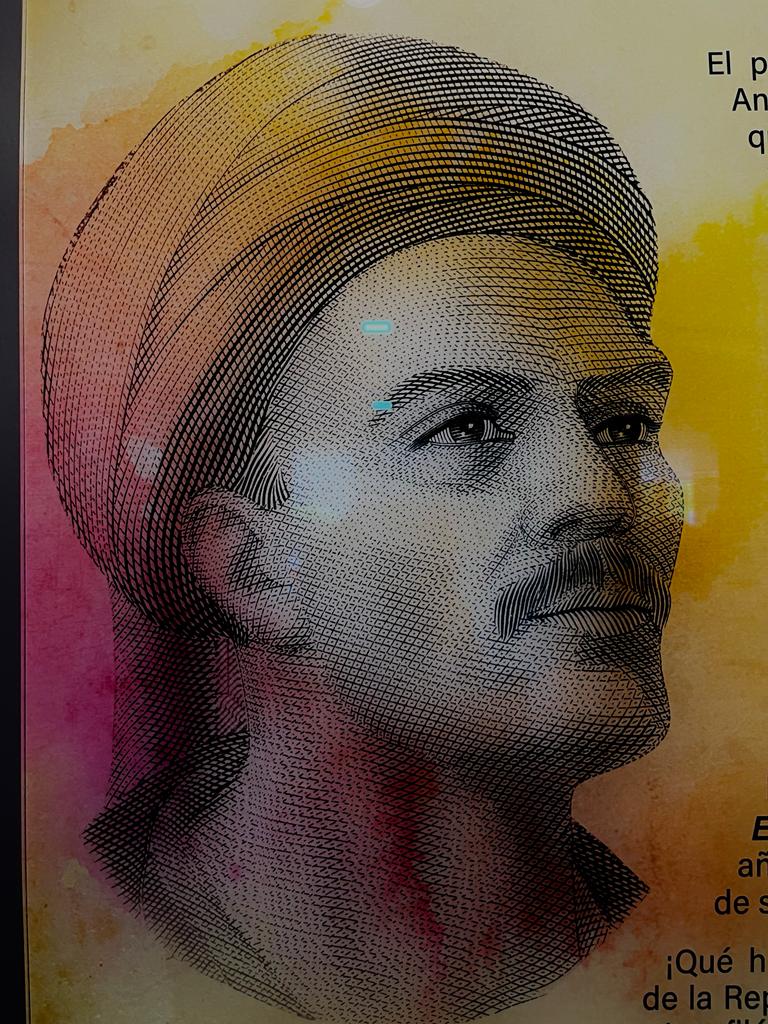
2. Historical and Cultural Context: The Sociological Anatomy of the Lands Where Yunus Was Raised
To understand Yunus Emre’s intellectual world, it is essential to analyze in depth the historical and cultural milieu in which he lived.
2.1. Political Turmoil and the Effects of Mongol Pressure on Social Psychology
This period, when the Anatolian Seljuk State weakened and the Mongol Ilkhanids expanded their influence, was not only a time of political decline but also of deep social trauma. The violence, plunder, and uncertainty brought by the Mongol invasions created a profound sense of insecurity and a search for meaning among the people. This collective trauma drove people to seek a spiritual refuge against the transience of the material world. Yunus’s criticisms of “worldly goods,” fame, and power are thus grounded in this historical background. His need to remind people that the truly valuable things are the everlasting spiritual treasures is a product of this chaotic environment.
2.2. Sufi Revival and the Social Role of Dervish Orders (Tariqas)
Political instability provided fertile ground for the sprouting of religious and Sufi movements. Great Sufis like Mevlana Jalal ad-Din Rumi, Hacı Bektaş-ı Veli, and Ahi Evran lived in Anatolia during this period and deeply influenced Yunus’s intellectual world. Sufism at this time was not only a belief system but also a network of social solidarity. Organizations like the Ahi Brotherhood organized economic life while prioritizing moral values. The ideal of the “perfect human” (al-insan al-kamil) in Yunus’s poems described not only a spiritually mature individual but also a person beneficial to society, with pure hands, tongue, and intention.
2.3. Construction of Linguistic Identity: The Rise of Turkish as the Language of the Heart
In an era when the official language was Persian and the language of science was Arabic, dervishes like Yunus Emre consciously chose Turkish to communicate directly with the people. This choice was not merely a practical medium of communication but also a cultural and national identity-building movement. By blending Turkish with the philosophical depth of Persian and Arabic, Yunus elevated it into a literary language capable of expressing profound thought. This has led to his poems being regarded not only as Sufi texts but also as foundational texts of the Turkish language.
3. Human and God in Sufi Thought: Wahdat al-Wujud and the Metaphysics of Love
The foundation of Yunus’s understanding of love is the doctrine of Wahdat al-Wujud (Unity of Being), especially as systematized by Ibn al-Arabi. According to this thought, absolute and true existence belongs only to God. Everything in the universe is nothing but His manifestation (tajalli) and reflection. This philosophical ground is the key to understanding Yunus’s love for humanity and God.
3.1. Love of God (Divine Aşk): A Longing for Union
For Yunus, the love of God is not ordinary devotion but a state of longing, yearning, and ultimately “union” (visal). The human being is essentially a part separated from God and burns with the desire to return to Him. Unlike worldly loves, this love is a process that annihilates the self (fana fi’Allah), making the individual perish in the Divine. This annihilation is, in fact, true existence in the Real Being. Yunus expresses this state in the following lines:
“Aşk aşkıla doldı cismümü canum / Aşk elünden oldı cümle yaralı“
(My body and soul were filled with love by love / We all became wounded by the hand of love)
3.2. Love for Humanity: The Practical Manifestation of Wahdat al-Wujud
The most radical and beautiful reflection of the idea of Wahdat al-Wujud in Yunus is the love for humanity. If everything is a manifestation of God, then it is impossible to hate or despise any created thing or any person. The human being, especially the “perfect human,” is the most perfect manifestation of God. Therefore, to love a human is to directly love God. Yunus’s saying, “I love the created for the Creator’s sake,” is the transformation of this deep metaphysical philosophy into a maxim understandable by the public. This love is not an abstract love but an active love that takes on flesh and blood and reflects onto all relationships.
4. The Crystalline Voice of Anatolian Turkish: Kneading Love with Language
Yunus Emre’s greatest achievement is transforming these profound metaphysical thoughts into a poetic language accessible to everyone, using the still-maturing Anatolian Turkish. His mastery of language can be examined under several headings:
4.1. The Power of Simplicity and Fluency
Yunus’s language is Turkish as spoken in daily life, free from complex Arabic and Persian constructions. This simplicity allowed his message to reach the hearts of the people directly. For example, even when narrating the miracle of the Prophet Solomon, he uses an extremely plain language:
“They said Solomon knows the language of birds / But Solomon (the heart) is within Solomon (the body)”
Here, he emphasizes that what truly matters is not external knowledge but the inner heart.
4.2. Master of Concretization and Similes (Tashbih)
Yunus is a master of conveying abstract concepts through concrete images. He describes love with words like “fire,” “pain,” “burning”; the heart as “place,” “home”; the journey of divine love with metaphors of “sea,” “ocean.” This enabled his teachings to be understood by people from all walks of life.
“Dervishhood is in the head, not in the crown / The fire that does not heat is not on the stove (hearth)”
In this line, he transforms the idea that dervishhood is not a matter of clothing or appearance into a wisdom understandable by everyone through a concrete metaphor (fire that does not heat on the stove).
4.3. Language Woven with Folk Idioms and Proverbs
He frequently uses idioms and proverbs of the people in his poems. This shows his sincere bond with the public and how well he grasped their language. This allowed his teaching to speak “in the language of the people” and thus take root.
4.4. The Educational Power of Rhythm and Harmony
His poems in the form of hymns (ilahi) possess a memorable rhythm and harmony suitable for composition. This musicality facilitated the transmission of his teachings from generation to generation within oral culture, enabling people to repeat his lines like a dhikr (remembrance of God).
5. Manifestations of Love for Humanity: Tolerance Embodied in Flesh and Blood
Yunus Emre’s love for humanity is not a theoretical love but a love reflected in practical life, transformed into action. The concrete reflections of this love can be seen as follows:
5.1. Universal Brotherhood Rejecting Distinctions of Religion, Language, Race
In his eyes, humans unite under the common denominator of “we are children of Adam.” He makes no distinction between Muslim-Christian, Turkish-Greek. Because all are manifestations of the same Divine Light. This universal perspective has made him a beloved figure not only in Anatolia but throughout the world.
“Whoever does not look upon seventy-two nations with the same eye / Even if they be a professor to people, in truth they are a sinner”
The expression “seventy-two nations” in this line encompasses all known human communities of that time and signifies an incredible inclusivity.
5.2. Humility and Compassion Against Arrogance and Hatred
The thing Yunus struggles against the most is a person seeing themselves as superior to others (arrogance). For him, the real enemy is not the external “other,” but the inner ego (self). Therefore, he constantly emphasizes humility and modesty.
“Knowledge is knowing / Knowledge is knowing oneself / If you do not know yourself / Then what kind of reading is it?”
This quatrain states that the ultimate goal of knowledge is to know one’s own ego, flaws, and impotence. This self-consciousness makes arrogance impossible.
5.3. Prioritizing Mending Hearts Over Worship
For Yunus, the Kaaba is not just a structure in Mecca. The true Kaaba is the human heart. Mending a heart is more valuable than circumambulating the Kaaba a thousand times. This is a revolutionary understanding that transcends religious practices and centers human relationships.
“If you once break a heart / This prayer you perform is not valid”
(If you once break a heart / This prayer you perform is not [a true] prayer)
6. Expression of Love for God: A Life Kneaded with Divine Love (Aşk)
For Yunus, the path to God is not through rigid rules and formalism but through sincere love and yearning.
6.1. A Belief System Based on Love, Not Fear
Yunus emphasizes loving God, rather than fearing Him. He advises worshipping not out of fear of Hell or expectation of Paradise, but solely for His love. This shifts religious motivation from external punishment and reward to an inner love and devotion.
“What they call Paradise / A few mansions and a few houris / Give them to those who want them / I need You, only You”
This famous quatrain is like a manifesto of his love-based belief system.
6.2. Discipline of the Ego (Nafs) in the Journey to Becoming the Perfect Human
The love of God is a process that matures the individual and melts away their ego. In this process, disciplining the ego (nafs), patience, gratitude, and continuous remembrance of God (dhikr) hold significant places. Yunus often describes this challenging inner journey through metaphors such as entering the “garden of the Friend” or burning with the “fire of love.”
6.3. Seeing Death Not as Separation but as Union
For Yunus, death is the very moment of union (visal) with the Beloved (God). Parallel to Mevlana’s concept of “şeb-i arus” (wedding night), he does not fear death but celebrates it as a moment of reunion. This perspective is a philosophy that radically changes the meaning of life and death, transforming the tragic into celebration.
7. Yunus’s Legacy: A Resounding Voice for Seven Centuries and Its Message to the Modern World
Yunus Emre’s legacy to humanity is invaluable both in terms of Turkish culture and universal values.
7.1. Yunus as One of the Founding Fathers of the Turkish Language
Yunus is one of the most important figures who made Turkish a literary and intellectual language. The language he used remains comprehensible even today and is shown among the finest examples of Turkish. This path he opened paved the way for the development of Turkish literature in subsequent centuries.
7.2. His Role in Shaping the Anatolian Understanding of Islam
His tolerant, loving, and human-centered interpretation of Islam deeply influenced the character of Islam practiced in Anatolia. His impact on orders like Mevlevism and Bektashism is significant. Behind the practical flexibility, love for humanity, and tolerance seen in the religiosity of the Anatolian people lie the ideas of Yunus Emre and dervishes like him.
7.3. The Embodiment of a Universal Discourse of Peace and Brotherhood
Yunus’s message has transcended boundaries and resonated worldwide. UNESCO’s declaration of 1991 as the “Yunus Emre Year of Love” was to announce his universal value to all humanity. His call, “Come, let us get to know each other,” is still a valid invitation for modern humans seeking dialogue between different cultures and beliefs.
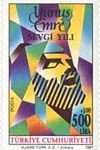
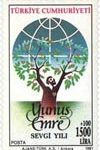
Commemorative stamps issued by PTT in memory of the 1991 UNESCO Yunus Emre Year of Love. Source: pulhane.com
7.4. An Antidote to the Crises of the Modern World
In the face of today’s increasing conflicts, othering, alienation, loss of meaning, and consumption frenzy, Yunus’s teachings serve as an antidote.
- Against Consumer Culture: His criticisms of “worldly goods” offer a powerful alternative to modern consumer society.
- Against Individualism and Loneliness: His recommendation to stop saying “only me” and become “us,” to achieve unity of heart, is a remedy for the loneliness of the modern individual.
- Against Othering: The understanding of “looking upon seventy-two nations with the same eye” emphasizes humanity’s common ground against today’s divisive political rhetoric.
8. Conclusion: Seeing the Yunus Way, or Seeing with the Eye of the Heart
Yunus Emre is not just a poet, but a seeker of truth, a physician of hearts, and a genius who made language the most powerful tool to express love. By using Anatolian Turkish to process deep philosophical and Sufi thoughts, he both enriched our language and found the most effective way to reach the people.
The essence of his teaching is “looking at the world the Yunus way.” That is:
- To see a divine essence in every person, whether Muslim or Christian, rich or poor,
- To possess a heart purified of arrogance, malice, selfishness, and prejudices,
- To approach every created thing – a flower, an insect, a human – with compassion and mercy,
- To see religion not as a tool of formalism and division, but of love and consciousness of unity,
- And finally, to turn towards the Only One, the Owner of everything, not with fear but with infinite love and longing…
This perspective is one of the most valuable spiritual prescriptions offered to divided, weary, and alienated modern humanity from seven hundred years ago. Yunus’s voice, rising from a village in Eskişehir, still echoes like a mighty plane tree across centuries and borders: “Come, let us get to know each other / Let us make our work easy / Let us love and be loved / The world stays with no one.” This is not merely a line of poetry but an eternal call of love, peace, and brotherhood directed at all humanity.
Bibliography and Further Reading Suggestions
Bibliography
- Tatçı, Mustafa. (1991). Yunus Emre Divanı (İnceleme-Metin) [Yunus Emre’s Divan (Analysis-Text)]. Kültür Bakanlığı Yayınları [Ministry of Culture Publications].
- Köprülü, M. Fuad. (2005). Türk Edebiyatında İlk Mutasavvıflar [Early Mystics in Turkish Literature]. Akçağ Yayınları.
- Gölpınarlı, Abdülbaki. (1992). Yunus Emre ve Tasavvuf [Yunus Emre and Sufism]. İnkılap Kitabevi.
- Ocak, Ahmet Yaşar. (2002). Alevi ve Bektaşi İnançlarının İslam Öncesi Temelleri [Pre-Islamic Foundations of Alevi and Bektashi Beliefs]. İletişim Yayınları.
- Uludağ, Süleyman. (2010). Tasavvuf Terimleri Sözlüğü [Dictionary of Sufi Terms]. Kabalcı Yayınevi.
- Cebecioğlu, Ethem. (2005). Tasavvuf Terimleri ve Deyimleri Sözlüğü [Dictionary of Sufi Terms and Idioms]. Ağaç Yayınları.
- Schimmel, Annemarie. (2018). Ben Rüzgârım Sen Ateş: Yunus Emre’nin Hayatı ve Şiirleri [I Am Wind, You Are Fire: The Life and Poems of Yunus Emre]. (Trans. Senail Özkan). Ötüken Neşriyat.
- Kaya, Doğan. (2000). Yunus Emre: Hayatı, Eserleri, Şiirlerinin Dili ve Açıklamalar [Yunus Emre: His Life, Works, Language of His Poems and Explanations]. Akçağ Yayınları.
- Ayan, Hüseyin. (1991). Yunus Emre: Risaletü’n-Nushiyye ve Divan [Yunus Emre: Risaletü’n-Nushiyye and Divan]. Türkiye İş Bankası Kültür Yayınları [Türkiye İş Bankası Cultural Publications].
- UNESCO. (1991). International Yunus Emre Year Symposium Proceedings.
Bibliography and Further Reading Suggestions
Bibliography
- Tatçı, Mustafa. (1991). Yunus Emre Divanı (İnceleme-Metin) [Yunus Emre’s Divan (Analysis-Text)]. Kültür Bakanlığı Yayınları [Ministry of Culture Publications].
- Köprülü, M. Fuad. (2005). Türk Edebiyatında İlk Mutasavvıflar [Early Mystics in Turkish Literature]. Akçağ Yayınları.
- Gölpınarlı, Abdülbaki. (1992). Yunus Emre ve Tasavvuf [Yunus Emre and Sufism]. İnkılap Kitabevi.
- Ocak, Ahmet Yaşar. (2002). Alevi ve Bektaşi İnançlarının İslam Öncesi Temelleri [Pre-Islamic Foundations of Alevi and Bektashi Beliefs]. İletişim Yayınları.
- Uludağ, Süleyman. (2010). Tasavvuf Terimleri Sözlüğü [Dictionary of Sufi Terms]. Kabalcı Yayınevi.
- Cebecioğlu, Ethem. (2005). Tasavvuf Terimleri ve Deyimleri Sözlüğü [Dictionary of Sufi Terms and Idioms]. Ağaç Yayınları.
- Kaya, Doğan. (2000). Yunus Emre: Hayatı, Eserleri, Şiirlerinin Dili ve Açıklamalar [Yunus Emre: His Life, Works, Language of His Poems and Explanations]. Akçağ Yayınları.
- Ayan, Hüseyin. (1991). Yunus Emre: Risaletü’n-Nushiyye ve Divan [Yunus Emre: Risaletü’n-Nushiyye and Divan]. Türkiye İş Bankası Kültür Yayınları [Türkiye İş Bankası Cultural Publications].
- UNESCO. (1991). International Yunus Emre Year Symposium Proceedings.
Further Reading Suggestions
Beginner Level
- Yunus Emre Divanı’ndan Seçmeler [Selections from Yunus Emre’s Divan] (Ed. Abdülbaki Gölpınarlı).
- Yunus Emre. Sabahattin Eyüboğlu.
Intermediate Level
- Yunus Emre: Dîvân – Tenkitli Metin [Yunus Emre: Divan – Critical Text]. Mustafa Tatçı.
- Yunus Emre. Cemal Kurnaz.
Advanced Level (Academic)
- Türk Edebiyatında İlk Mutasavvıflar [Early Mystics in Turkish Literature]. M. Fuad Köprülü.
- Babaîler İsyanı Aleviliğin Tarihsel Altyapısı Yahut Anadolu’da İslâm-Bizans Sentezi [The Babai Revolt: The Historical Infrastructure of Alevism or the Islamic-Byzantine Synthesis in Anatolia]. Ahmet Yaşar Ocak.
- Mystical Dimensions of Islam. Annemarie Schimmel.
Related Novels and Essays
- Buğra, Tarık. Osmancık.
- (Note: Novel, traces of the Yunus-like spirit in the foundation of the Ottoman Empire).
- Meriç, Cemil. Bu Ülke [This Country].
- (Note: Essay, deductions on the Turkish intellectual world).
⚖️
License and Copyright Notice
Media usage rules
Check the license/copyright information for all media files (images, videos, audio, documents, etc.) included in this content from the relevant work descriptions.
📚 Read the Terms and Conditions