

Animal Symbolism in Rumi’s Mesnevi: Sufi Wisdom Through Timeless Tales
Explore the profound Sufi interpretations of animal stories in Rumi's Mesnevi. Discover how the fox, lion, parrot, and elephant symbolize the nafs, divine love, and the path to becoming the Perfect Human Being.
The Essence of the Word and the Language of Symbols
The “Mesnevi” is not merely a literary masterpiece; it is also an “ocean of wisdom” that speaks to hearts and guides those seeking truth. In this unique work, Mevlânâ Celaleddin-i Rumi narrates the inner journey of the human being, the struggle against the carnal self, the longing for divine love, and ultimately the ideal of becoming the “Perfect Human Being.” However, rather than conveying these profound and abstract truths directly, he often makes use of everyday life, mythology, and especially animal stories. This is the cornerstone of his pedagogy and his universal message.
Mevlânâ does not use animals such as the fox, the lion, the bee, the elephant, the donkey, and the parrot as ordinary characters. They become symbols representing various states, weaknesses, and virtues of the human soul. While entertaining the reader, these stories also make them reflect; rather than giving simple advice, they function as a mirror, prompting one to turn inward and ask, “Could this fox be me?”. In this article, we will look at the vast world of the Mesnevi through the lens of animal symbolism and explore the Sufi interpretations of these charming yet profoundly deep stories.
1. The Sufi Framework Underlying the Animal Allegories
In order to make sense of Mevlânâ’s animal stories, it is first necessary to understand the fundamental Sufi concepts. These stories are built upon these concepts.
- Nafs (Self/Ego): In Sufism, the most fundamental element that veils the human being from truth and binds them to the world and its pleasures is the nafs. The nafs has different stations, and the ultimate goal is to discipline it, transforming it from the state of “ammāra” (the soul that commands evil) to the state of “mutma’inna” (the soul at peace). Many animals represent different aspects of the nafs.
- Universal Intellect (ʿAql-i Kull) vs. Partial Intellect (ʿAql-i Juzʾ): The limited, calculative intellect of the human being (Partial Intellect) is often insufficient to perceive the truth. Whereas one must connect to the Universal Intellect (ʿAql-i Kull) and surrender to divine guidance. In the animal stories, characters who act with their partial intellect and fall into a trap symbolize this situation.
- Love (Divine Love): According to Mevlânâ, the supreme path to truth is love, not intellect. Love is a touchstone that frees the individual from the self and leads to the Truth. Some stories depict the ecstasy and sacrifice of this love.
- Death and Fanāʾ Fillāh (Annihilation in God): The death of the worldly self, its annihilation in the Ultimate Being, is the final goal of the Sufi path. This is a metamorphosis like a caterpillar turning into a butterfly. Some animal stories narrate this symbolic death and rebirth.
2. Unforgettable Animal Stories from the Mesnevi and Their Deep Interpretations
2.1. The Fox and the Camel: The Deceit of the Nafs and the Danger of Blind Obedience
Story Summary: A hungry fox befriends a camel and promises to lead it to a lush garden. To enter the garden, they must pass through a low hole. The fox enters easily and eats its fill. When it comes out, it convinces the camel to enter by describing the garden’s beauties, knowing full well the camel will not be able to get out. Trusting the fox’s words, the camel enters the garden and eats its fill. However, the fox has already hatched a plan with the gardener. When the gardener comes, the fox flees, while the large camel, unable to fit through the hole, is caught and killed by the gardener.
Sufi Interpretation:
- The Fox: Represents the “Commanding Self” (Nafs-i Ammāra) itself. It is greedy, deceitful, selfish, and constantly seeks its own benefit. The nafs invites the human being (the camel) to the transient pleasures of the world’s garden (wealth, property, lust, status). It leads one into sin by whispering, “Just this once, nothing will happen.” Yet, in the end, the nafs abandons the person alone and in difficulty, ensuring its own salvation.
- The Camel: Represents the “Person Who Blindly Imitates and Does Not Question the Truth.” It is symbolic that the camel is physically large but lacking in intellect and foresight. This is the state of a person who blindly follows not a spiritual guide (murshid), but their own nafs or the wrong people, without questioning their words. The person falls for the tricks of the nafs and Satan, indulges in the transient pleasures of the world, and ultimately perishes spiritually. The story is a warning: “Do not follow your nafs; do not fall for its tricks!”
2.2. The Elephant and the Men in the Dark Room: The Oneness of Truth and the Lack of Perspective
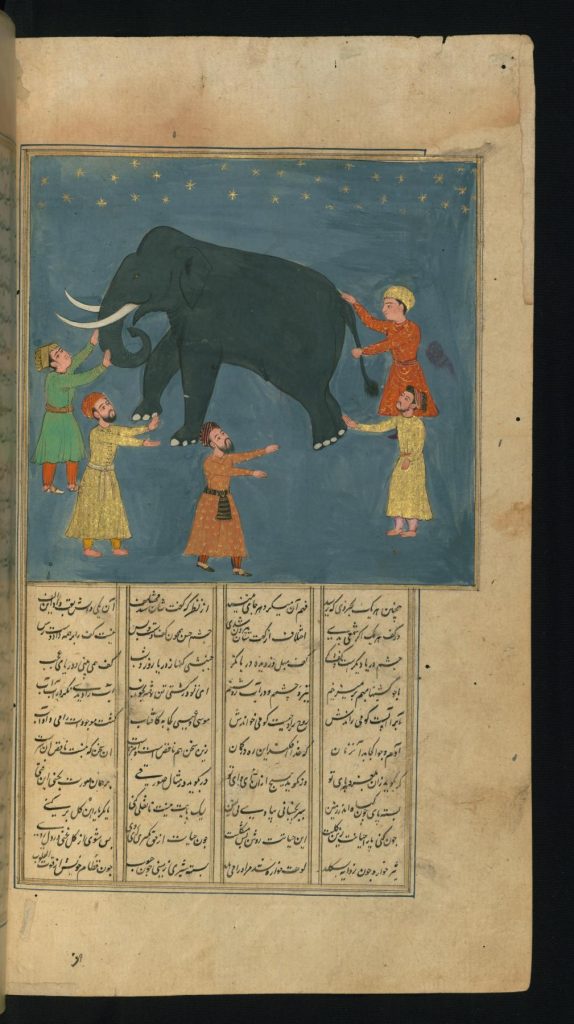
Story Summary: Some Hindus want to introduce an elephant to a group of men who have never seen one before. They place the men in a dark room and let each of them touch a different part of the elephant. One touches the trunk, another the ear, another the leg, and another the tail. When they come out, each describes the elephant according to the part they touched. The one who touched the trunk likens it to a “water spout,” the one who touched the ear to a “fan,” the one who touched the leg to a “pillar,” and the one who touched the tail to a “rope.” Each insists on his own truth, and they begin to quarrel.
Sufi Interpretation:
- The Elephant: Represents “Absolute Truth,” “God,” or the “Unity of Being” (Wahdat al-Wujūd). Truth is one and whole.
- The Dark Room: Symbolizes the limited senses, narrow perspective, and worldly veiling of the human being. A person can perceive truth only as much as their capacity and perspective allow, not as it truly is.
- The Men: Represent the followers of different sects, religions, philosophies, and beliefs. Each sees only a part of the truth and imagines it to be absolute. By insisting on their own perceived truth and rejecting the views of others, they fall into conflict. With this story, Mevlânâ conveys the message: “Truth is one; you are able to see only a part of it. Respect the parts seen by others, and try to see the whole.” This is one of the most beautiful expressions of tolerance and humility.
2.3. The Bee and Honey: Diligence and Lawful Sustenance
Story Summary: Mevlânâ praises the bee’s disciplined work, its taking only what is pure and lawful, and transforming it into a beneficial product (honey). The bee sucks the essence of flowers without harming them. It processes everything it gathers within itself, turning it into a valuable blessing.
Sufi Interpretation:
- The Bee: Represents the “Righteous Servant” or the “Seeker of Truth (Tālib).”
- The Essence of the Flowers: Represents the transient blessings, knowledge (ʿilm), and wisdom (hikmah) in the world.
- Honey: Represents “Mystical Knowledge (Maʿrifah),” “Wisdom (Hikmah),” and “Righteous Deeds (ʿAmal Sālih).” The bee takes its share from the world but does not become attached to it. It processes what it takes through a spiritual transformation, turning it into “honey”—spiritual accumulation—that benefits both itself and its surroundings. This story counsels not a total rejection of the world, but rather benefiting from it lawfully and spiritually processing what is gathered to advance on the path of becoming the “Perfect Human Being.” It emphasizes the virtues of diligence, purity, and productivity.
2.4. The Parrot and the Secret of the Dye: The Importance of Essence and the Worthlessness of Imitation
Story Summary: A talking parrot sits in a cage in an oil merchant’s shop. One day, the merchant’s son drops and breaks a jar while carrying oil barrels. The merchant becomes furious and starts beating his son on the head with whatever he has. The parrot, having witnessed this scene of violence, stops speaking after a while. The merchant, thinking the parrot has died, takes it out of the cage and throws it outside. However, the parrot hasn’t actually died; it merely imitated death. It flies away and gains its freedom.
Sufi Interpretation:
- The Parrot: Represents “Imitative Faith” or “Worship for Show (Riyāʾ).” The parrot’s speech consists of repeating memorized words without understanding their meaning. This resembles the rituals performed by many religious people without grasping their deep significance.
- Feigning Death: Signifies “the slaying of the nafs (dying before dying)” or “being saved from imitative faith and embarking on a genuine quest.” The parrot attained its freedom by abandoning imitation (ceasing to speak) and returning to its essence.
- Freedom: Represent “Genuine Faith” and “Spiritual Liberty.” With this story, Mevlânâ says: “Worship performed merely through imitation, without knowing its meaning, will not lead you to truth. You must first cause that imitation to ‘die’—that is, abandon it—and pursue the meaning to grasp the essence. Only then will you be truly free.”
2.5. The Lion, the Wolf, and the Fox: Justice and Merit
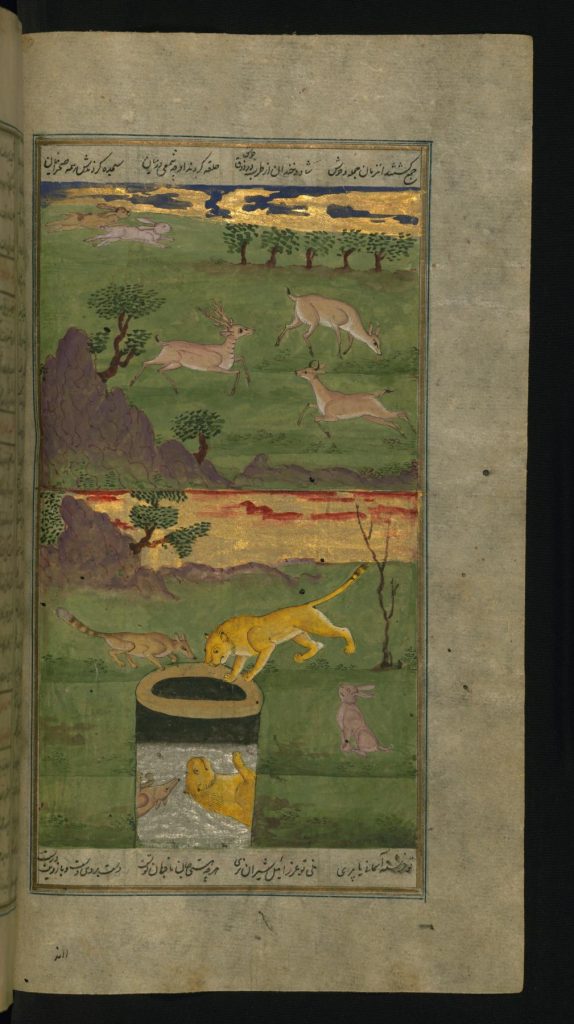
Story Summary: The lion, the king of the forest, summons his viziers, the wolf and the fox, to divide a gazelle he has hunted. The wolf, trying to flatter the lion, divides the gazelle into four equal parts: “The first part is for you, our king. The second part is for us, your viziers. The third part is for the hunters and servants. The fourth part is for the common people.” Angered by this division, the lion tears the wolf to pieces. Then it is the fox’s turn. The fox says, “The entirety of this gazelle belongs to our great sultan.” Pleased with this answer, the lion rewards the fox.
Sufi Interpretation:
- The Lion: As the “Absolute Ruler” or “Sultan,” it can represent God or a saint (walī). It also symbolizes “Power” and “Will.”
- The Wolf: Represents the “Nafs that Engages in Hypocrisy and Sycophancy.” It acts for show, looking out for its own interests rather than merit. Its end is ruination.
- The Fox: Represents the “Wise and Insightful Servant.” It knows the truth and speaks accordingly. In fact, the fox’s answer points to the state of “Fanāʾ Fillāh” (Annihilation in God) in Sufism. The servant realizes that he owns nothing, that everything belongs to the Truth (Haqq). He has rid himself of the sense of “I-ness.” This story emphasizes the importance of sincerity, truthful speech, and not falling for the sycophancies of the nafs.
3. Common Themes and Messages for Today
There are several themes common to all of these stories:
- Self-Knowledge: Each story pushes the reader to question their own inner state. The question, “Which animal’s characteristics do I carry?” initiates a self-examination of the nafs.
- The Limits of the Intellect and the Power of Love: While demonstrating the insufficiency of mere intellect, Mevlânâ intimates that the path to truth is through “love” and “intuition.”
- The Quest for Freedom: As in the parrot story, all the stories, albeit indirectly, narrate the human desire to break free from material and spiritual chains and attain liberation.
- Tolerance and Wholeness: The elephant story carries an incredible message of tolerance and dialogue in today’s polarized world.
Conclusion: The Eternal Truth Behind the Symbols
Although written centuries ago, the animal stories in Mevlânâ’s Mesnevi still retain their freshness and relevance today because they shed light on the universal truths of human nature. Rather than giving a didactic lesson, these stories aim to be a means for an awakening in the reader’s heart. They offer a universal language that narrates the tricks of our nafs, our limited perspective, our need to turn from imitation towards truth, and ultimately our desire to unite with divine love.
The eternal truth behind these symbols is the human being’s journey of inner transformation. Through his fox, lion, bee, and parrot, Mevlânâ holds up a mirror to each of us and asks the question: “Where are you in the story, and which step will you take on the path to becoming truly ‘human’?” The answer to this question awaits rediscovery, with every reading, within the pages of the Mesnevi.
Bibliography and Further Reading Suggestions
Fundamental Translations and Commentaries of the Masnavi (in Turkish)
- Rûmî, Mevlânâ Celâleddîn-i. Mesnevî-i Ma’nevî.
- Can, Şefik (Trans. and Comm.).Mesnevî [Masnavi] (6 Vols.). Ötüken Neşriyat.
- (Note: It is one of the most widely accepted, fundamental, and comprehensive modern translations and commentaries).
- Gölpınarlı, Abdülbâki (Trans. and Comm.).Mesnevî [Masnavi] (6 Vols.). İnkılâp Kitabevi.
- (Note: An indispensable classic for academic and traditional interpretations).
- Okuyucu, Cihan (Comm.).Mesnevî Tercümesi ve Şerhi [Translation and Commentary of the Masnavi] (10 Vols.). Akçağ Yayınları.
- (Note: A highly detailed and up-to-date commentary work).
Special Studies on Stories and Symbolism in the Masnavi
- Türkmen, Erkan.Mesnevî’deki Hayvan Hikayelerinin Şerhi [Commentary on Animal Stories in the Masnavi]. Rumi Yayınları.
- (Note: The most specific source directly related to the subject of this article).
- Can, Şefik.Örneklerle Mesnevî Okumaları [Masnavi Readings with Examples]. Ötüken Neşriyat.
- (Note: Explains the stories by connecting them to daily life; it is an easily accessible source).
- Câmî, M. A. (Ed. C.Y. Öztürk).Mesnevî’den Hikâyeler ve Hayvan Sembolizmi [Stories from the Masnavi and Animal Symbolism]. Anahtar Kitaplar Yayınevi.
- (Note: A work compiled specifically for this subject).
General Resources on Understanding Sufism and Rumi
- Schimmel, Annemarie.Ben Rüzgârım Sen Ateş: Mevlânâ Celâleddin Rumi’nin Hayatı ve Eseri [I Am Wind, You Are Fire: The Life and Work of Rumi]. Kabalcı Yayınevi.
- (Note: An excellent introductory book that explains Rumi’s world through the eyes of a Western academic).
- Chittick, William C.The Sufi Path of Love: The Spiritual Teachings of Rumi. State University of New York Press.
- (Note: A systematic examination of Rumi’s teachings for English readers).
- Sârâb, Abdülkadir.Mevlânâ ve Tasavvuf [Rumi and Sufism]. İnsan Yayınları.
- (Note: A local source that handles Rumi’s thought in a Sufistic context).
Notes for Research and Citation
- All of the sources above are fundamental works where you can find the original texts and different interpretations of the stories mentioned in the article.
- Especially the translations by Şefik Can and Abdülbâki Gölpınarlı can be used as academic references, as they provide the volume and couplet numbers where each story is located.
- Erkan Türkmen‘s book is a direct primary source that supports the main ideas of this article.
⚖️
License and Copyright Notice
Media usage rules
Check the license/copyright information for all media files (images, videos, audio, documents, etc.) included in this content from the relevant work descriptions.
📚 Read the Terms and Conditions